
Request an appointment
Reserve your spot with our team in just minutes.
Other Knee Treatments
Knee Injections in London
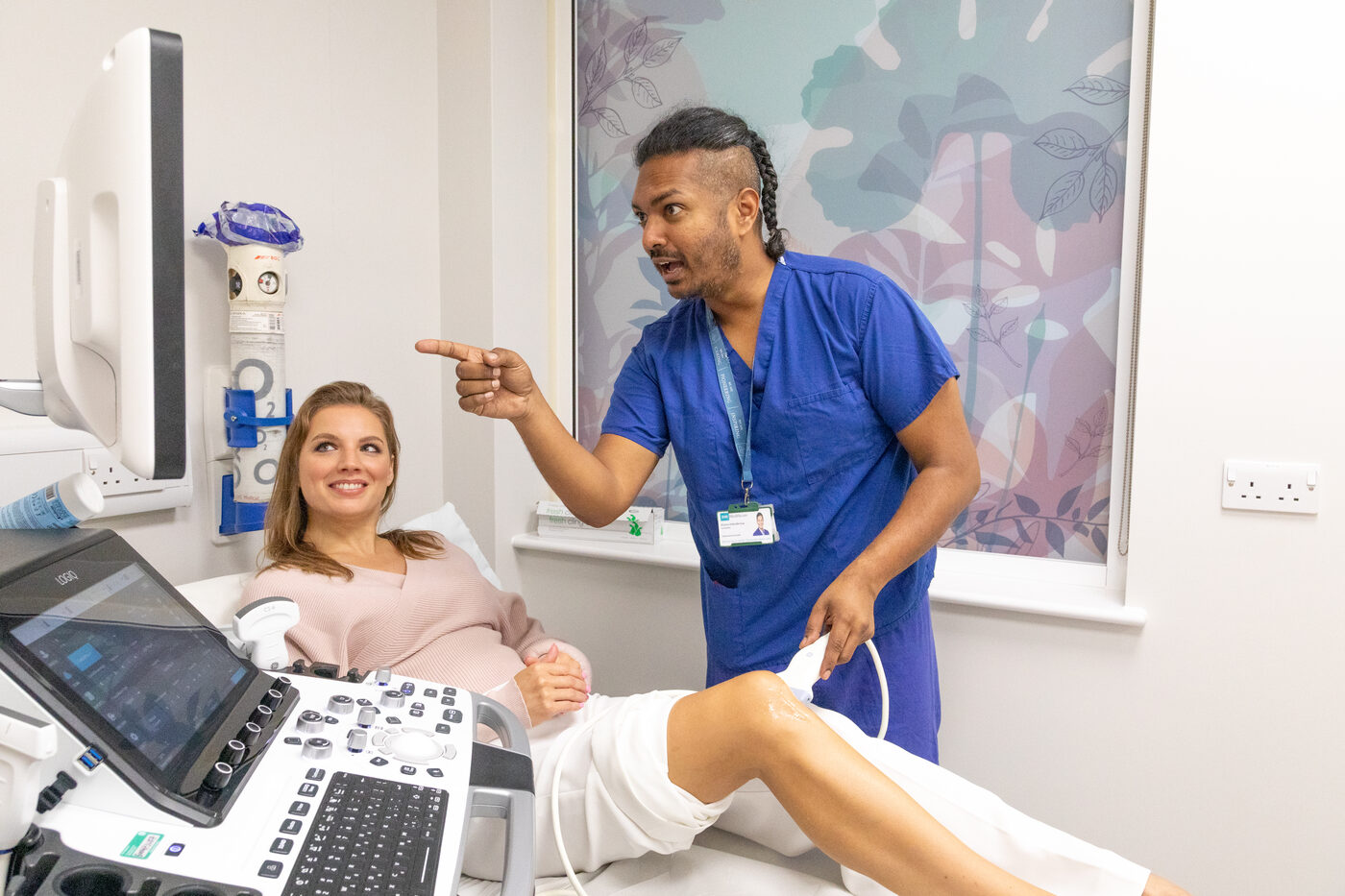
If your knee hurts and you are not ready for an operation, or do not need one, this clinic is for you. I will always start with the least invasive treatment that has a fair chance of helping your knee.
I run a consultant-led knee injection clinic in Mayfair, with further clinics in Chiswick and Brentford. Every injection in clinic is guided by ultrasound, which I perform myself, and is given only after a proper assessment of your knee. The options include high-dose PRP made from your own blood, hyaluronic acid and Arthrosamid knee gels, and bone marrow concentrate, and the evidence for each is set out below. Which one, if any, depends on your knee and your goals.
Written and medically reviewed by Dr Arj Imbuldeniya, Consultant Orthopaedic Knee and Hip Surgeon. Last reviewed 8 November 2026. The studies behind this page are listed at the end.
Free 60-second assessment
How old are your knees?
Your knees have a biological age, and it is often not the age on your passport. Of the people who have taken this test, 55 per cent found their knees were older than they are, and one in eight by ten years or more. Sixty seconds, free, and you get one number and the single change that would take the most years off it.
Find my Knee Age, free →Which knee injection is right for me?
The right knee injection is the one that matches the cause of your pain, the amount of healthy cartilage you still have, and what you want your knee to do next year, and for some people the honest answer is no injection at all.
Patients usually arrive with one of two stories. Some have been told by a friend, or by the internet, which injection they need, and want it booked. Others have had three injections elsewhere, none of them guided, none of them measured, and are no longer sure any of it works. Both deserve the same thing first: a proper diagnosis, an examination, imaging where it adds something, and a conversation about your life rather than just your scan.
No two patients with the same knee leave with the same plan. Your weight, your general health, your sleep, your work, the stairs you climb and the people you look after all shape what will actually help. An injection is added on top of a strength and load plan when that plan is in place and the injection will genuinely move things forward. We do not try everything at once and hope something works.
Ultrasound-guided knee injections
Ultrasound guidance means the medicine goes exactly where it is meant to go, rather than where a needle happens to land.
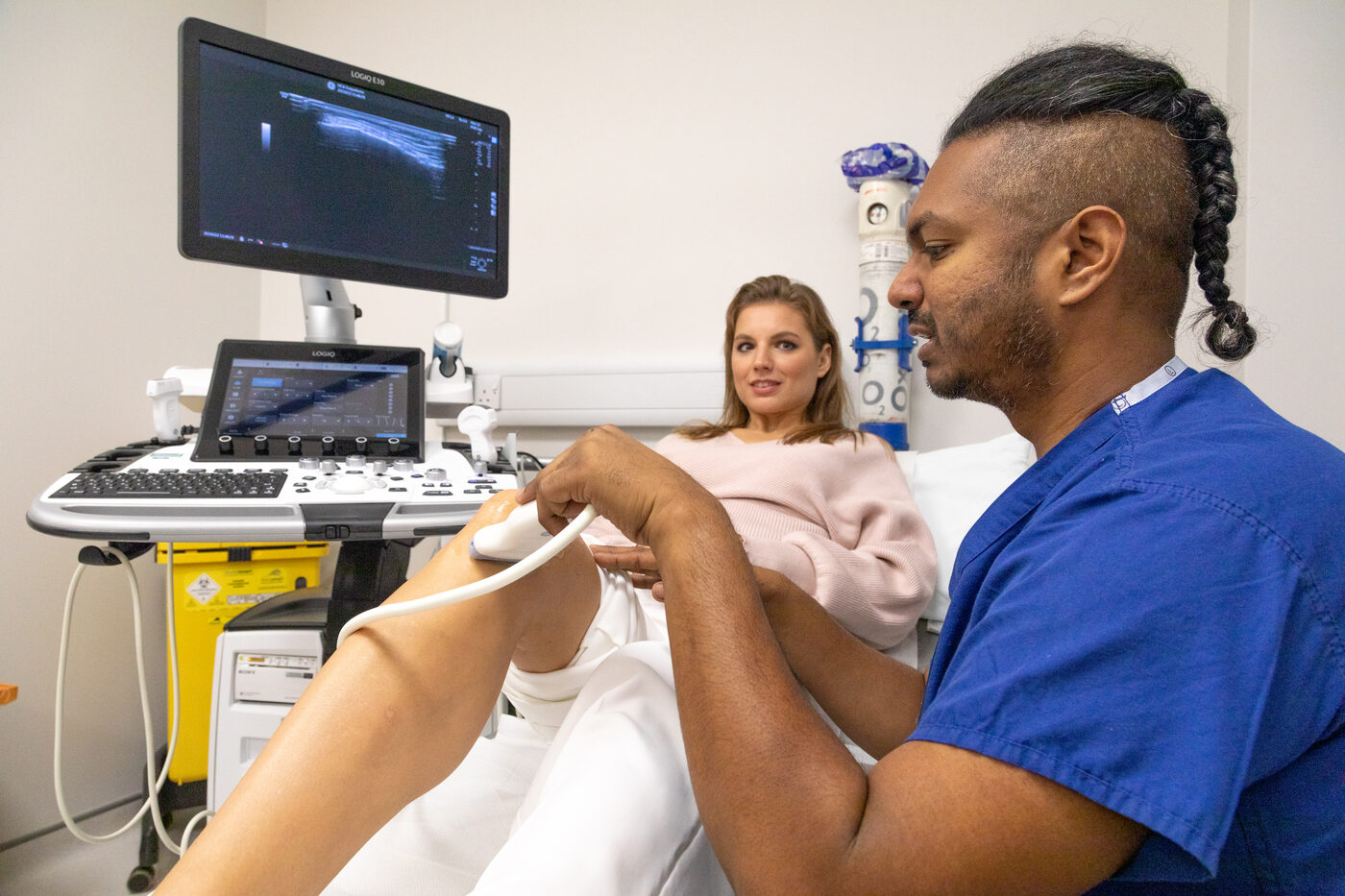
I perform every knee injection myself under ultrasound, at Lanserhof at The Arts Club in Mayfair, in Chiswick and at Syon Clinic in Brentford. Seeing the joint in real time lets me check for fluid, drain it first if needed, and place the injection inside the joint with confidence. It also means that if an injection does not help, we know it was not because it missed.
The Mayfair clinic is a short journey from Kensington, Chelsea and Notting Hill, and the Chiswick and Brentford clinics are closer for Ealing, Richmond and Twickenham. Whichever clinic you choose, it is the same consultant, the same ultrasound and the same standard of assessment.
Knee injections compared: what the research shows
Each injection does a different job. This is what the best available studies show.
| Injection | What it is | What the best studies show | UK guidance (NICE) |
|---|---|---|---|
| PRP | A concentrate of platelets from your own blood | Less pain and better function than placebo for up to 12 months in pooled trials [1], although one large trial found no benefit [2]; a little more relief than hyaluronic acid at 12 months [3] | No major safety concerns; evidence of benefit is still limited, so NICE asks for careful consent and audit [4] |
| Hyaluronic acid | A lubricating gel, Ostenil Plus | Compared with placebo, pain falls by an amount too small for most people to notice [5] | Do not offer for arthritis [6] |
| Arthrosamid | A permanent polyacrylamide gel | In its randomised trial, as good as hyaluronic acid over a year [7]; improvement lasted to five years on average in those followed up [8] | No guidance: not enough evidence yet [9] |
| Bone marrow concentrate (BMAC) | A concentrate of your own bone marrow | As good as PRP at two years [11]; knees improved equally with BMAC and salt water in a trial where each person had both [10] | Stem cell injections are experimental, for research only [12] |
| Steroid | An anti-inflammatory medicine, prescription only | Short-term relief; injections every three months for two years eased pain no more than salt water [13] | Consider for short-term relief of 2 to 10 weeks, to support exercise [6] |
None of these injections has been shown to regrow cartilage, and none replaces exercise, which NICE recommends for everyone with knee arthritis, along with weight loss for those who need it [6].
Steroid (cortisone) knee injection
A steroid injection can calm an inflamed, swollen knee for a few weeks [6]. It may be considered when inflammation is driving the pain and a window of relief would get your rehabilitation going, but it is not a long-term answer, and repeated injections into the same knee are something I keep to a minimum. It costs £500. My steroid knee injection page explains the evidence.
Knee gel injections: hyaluronic acid and Arthrosamid
When people ask for a knee gel injection they usually mean one of two very different treatments: hyaluronic acid, which lubricates the joint for a period of months, or Arthrosamid, a hydrogel designed to stay in the knee.
Hyaluronic acid, which I use as Ostenil Plus, costs £700. It tops up the joint's lubricating fluid, but large trials show little benefit over a placebo injection and NICE advises against it [5,6], so I explain this before anyone chooses it. More detail is on my hyaluronic acid knee injection page.
Arthrosamid is a different category altogether. It is a cross-linked polyacrylamide hydrogel that integrates into the lining of the joint and is intended to give long-lasting relief from a single treatment, at £3,500. It is a serious option for people with established knee arthritis who are not ready for, or not suited to, a knee replacement. I explain who it helps, and who it does not, on my Arthrosamid knee gel injection page. In its randomised trial it eased pain as much as hyaluronic acid [7].
PRP knee injections (platelet-rich plasma)
PRP uses a concentrate of your own platelets to calm inflammation and support the tissues of the knee, and for knee arthritis I use high-dose PRP, a single injection at £2,050. Standard PRP, at £950 per injection, is used mainly for tendon problems as a course of three.
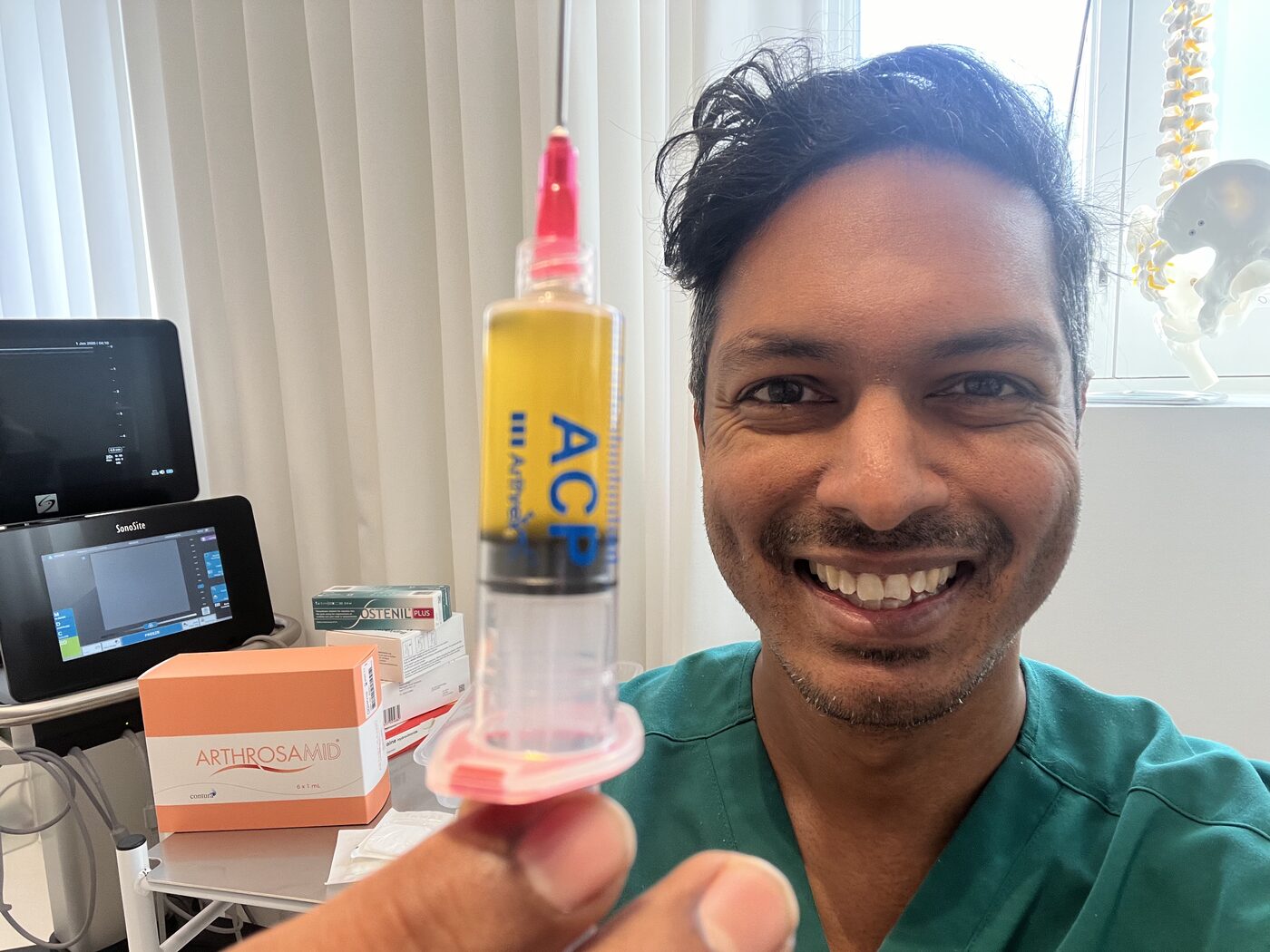
High-dose PRP, using the Arthrex ACP Max system, starts from a much larger blood sample and delivers a far greater number of platelets than a standard preparation. For the right knee, at the right stage, it is one of the most useful biological tools I have. For the wrong knee it is an expensive disappointment, which is why the assessment comes first. See my PRP knee injection page for how I decide.
Stem cell knee injections (BMAC)
A BMAC injection uses bone marrow aspirate concentrate taken from your own pelvis, and it is what most people mean when they search for a stem cell knee injection.
I want to be plain about it: nothing currently available regrows lost cartilage, and nothing is a cure for arthritis. BMAC is a biological treatment that may reduce pain and inflammation in carefully selected patients, sometimes alongside surgery. My BMAC stem cell knee treatment page sets out what the evidence does and does not show.
How much do knee injections cost in London?
I publish my injection fees so you know the cost before you book: a steroid injection is £500, hyaluronic acid (Ostenil Plus) is £700, high-dose PRP is £2,050 (standard PRP for tendons is £950 per injection, usually as a course of three), Arthrosamid is £3,500, and bone marrow concentrate, done in theatre at Cromwell Hospital, is £6,940.
A new consultation is £350, and every injection follows an assessment, because the right decision matters more than the quickest one. My full fee schedule is on the pricing page, and my team will always confirm the cost in writing before anything is booked.
When an injection is not the answer
Sometimes the right treatment is not an injection at all, and as a surgeon I will tell you when that is the case.
Knee care goes wrong in two directions. Some people are injected again and again when the joint has moved beyond what an injection can do, and they lose years waiting. Others are rushed to an operation they never needed. Because I offer both, I have no reason to push you towards either. If your knee needs a robotic knee replacement, a partial knee replacement or a meniscus repair, I will say so, and explain why. If you would like to see how your knees compare with your age before you book, try the free Knee Age quiz.
Two questions come up often enough that I have written a page on each: does PRP help a meniscus tear heal? and does PRP help an ACL tear or ACL reconstruction?
How my team and I look after you
An injection is never the whole plan. It works best alongside the things that make a real difference to a sore knee, which are strength, weight and movement, so my team and I put those in place with you, often together with one of the physiotherapists I work with.
If I do not think an injection will help your knee, I will tell you before you spend anything. And because I am an operating surgeon, I will also tell you plainly if your knee has reached the point where an operation would serve you better than another injection.
Thinking about a knee injection?
Book a consultation and we will work out which treatment, if any, is right for your knee.
Patient stories
Real feedback from our patients
Three patients describe what having a knee injection with me was like.

Kind, gentle and quick
Dr Arj was so kind, gentle, very helpful, explained the procedure well before applying the injection. It was so quick and I didn't feel a pain when I left. Thank you so much.
Verified patient, Doctify, September 2025
Put at ease straightaway
Dr Arj Imbuldeniya was professional, caring and friendly, he put me at ease straightaway. He actively listened to my concerns and explained my condition and the next steps/procedure very clearly in a way that I was able to understand. Such a positive experience. Thank you.
Verified patient, Doctify, April 2025
Needle phobia, positive experience
It was a great experience even though I am needle phobic and was a little nervous! Dr Arj Imbuldeniya has a very calm, reassuring bedside manner, which enabled him to talk me through and carry out the injections to BOTH of my knees in one appointment.
Ceri B., Google review, January 2025
Knee Injection Questions
A steroid injection is £500, hyaluronic acid is £700, high-dose PRP is £2,050 (standard PRP for tendons is £950 per injection, usually as a course of three), Arthrosamid is £3,500 and bone marrow concentrate is £6,940. A new consultation is £350, and every injection is ultrasound-guided and follows a proper assessment.
A knee gel injection usually means either hyaluronic acid, which lubricates the joint for several months, or Arthrosamid, a hydrogel designed to stay in the knee and give long-lasting relief. They suit different knees, so the choice follows an assessment.
Yes. I perform every knee injection myself under ultrasound guidance, so the treatment is placed precisely inside the joint.
I inject at Lanserhof at The Arts Club in Mayfair, in Chiswick and at Syon Clinic in Brentford. Most self-funding injection patients are seen in Mayfair.
At my clinic a hyaluronic acid knee gel injection (Ostenil Plus) is £700 and an Arthrosamid hydrogel injection is £3,500, both ultrasound-guided and given after a consultation, which is £350 for a new patient.
A hyaluronic acid knee injection (Ostenil Plus) costs £700 with me, given under ultrasound guidance after a consultation.
High-dose PRP for knee arthritis is a single ultrasound-guided injection costing £2,050. Standard PRP, used mainly for tendon problems as a course of three, is £950 per injection.
High-dose PRP delivers a very large number of your own platelets, around 8 to 10 billion in my practice, prepared from a 60 to 90ml blood sample using the Arthrex ACP Max system, rather than the small sample used in many standard kits.
The main types are steroid (cortisone) to calm inflammation, hyaluronic acid to lubricate the joint, PRP made from your own platelets, Arthrosamid hydrogel for longer-lasting relief in arthritis, and bone marrow concentrate in selected cases. Each suits a different knee at a different stage.
Injections do not repair cartilage, they do not work for everyone, and some, such as Arthrosamid and high-dose PRP, cost more. Steroid relief can be short-lived, and repeated steroid injections are best kept to a minimum. Any injection carries a small risk of infection, which ultrasound guidance and sterile technique keep low.
Yes. You can walk out of clinic and go about your day, though I suggest taking it easy for a day or two and avoiding heavy exercise. You should not drive immediately if the knee feels numb from the local anaesthetic.
You can book online through the website, call my team on 0207 859 4016 or email admin@ortholongevity.co.uk. If you are insured, check with your insurer whether they need a GP referral first.
Choose a clinic where a consultant examines you first, guides the injection with ultrasound, explains which injection suits your stage of arthritis and why, and is open about prices and the evidence. Be wary of anywhere that offers the same injection to everyone.
References
- Bensa A et al. PRP versus placebo for knee arthritis, meta-analysis of 18 trials. Am J Sports Med 2025;53(3):745-54. doi.org/10.1177/03635465241246524
- Bennell KL et al. RESTORE trial: PRP versus salt water injections for knee arthritis. JAMA 2021;326(20):2021-30. doi.org/10.1001/jama.2021.19415
- Li YF et al. PRP versus hyaluronic acid, double-blind trials only. Arthroscopy 2025;41(12):5304-18. doi.org/10.1016/j.arthro.2025.06.033
- NICE HTG497 (formerly IPG637): platelet-rich plasma injections for knee osteoarthritis. nice.org.uk/guidance/htg497
- Pereira TV et al. Hyaluronic acid injections for knee arthritis, meta-analysis of 169 trials. BMJ 2022;378:e069722. doi.org/10.1136/bmj-2022-069722
- NICE NG226: osteoarthritis in over 16s, diagnosis and management (2022). nice.org.uk/guidance/ng226
- Bliddal H et al. Arthrosamid versus hyaluronic acid, randomised trial. Clin Exp Rheumatol 2024;42(9):1729-35. pubmed.ncbi.nlm.nih.gov/38525999
- Bliddal H et al. Five-year follow-up of the Arthrosamid group in the randomised trial. Clin Exp Rheumatol 2026;44(7):1410-7. pubmed.ncbi.nlm.nih.gov/41779591
- NICE topic decision: Arthrosamid not selected for guidance because of insufficient evidence (August 2023). nice.org.uk/guidance/prioritisation/gid-htg11047
- Shapiro SA et al. Bone marrow concentrate in one knee, salt water in the other, randomised trial. Am J Sports Med 2017;45(1):82-90. doi.org/10.1177/0363546516662455
- Anz AW et al. Bone marrow concentrate versus PRP, the same trial at 24 months. Am J Sports Med 2022;50(3):618-29. doi.org/10.1177/03635465211072554
- NICE NG226: rationale, stem cell injections are experimental. nice.org.uk/guidance/ng226/chapter/rationale-and-impact
- McAlindon TE et al. Steroid injections every 3 months for 2 years versus salt water, randomised trial. JAMA 2017;317(19):1967-75. doi.org/10.1001/jama.2017.5283
Patient Reviews
What Our Patients Say
Verified Doctify reviews from patients who have received knee injection treatment under the care of Dr Arj Imbuldeniya at OrthoLongevity.