
Request an appointment
Reserve your spot with our team in just minutes.
Other Hip Treatments
Which Hip Replacement Approach Is Best?
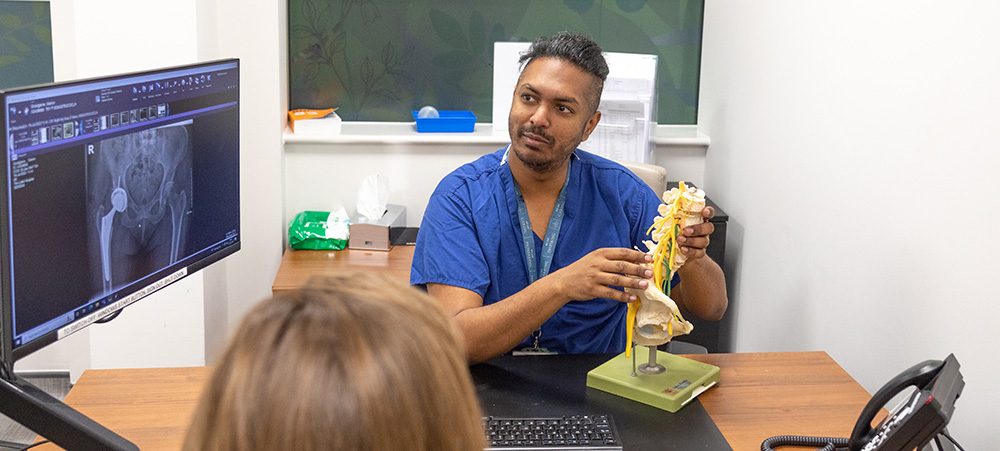
The honest answer from a London hip surgeon who performs both anterior and posterior hip replacement: there is no single best approach, and any surgeon who tells you otherwise is usually describing the only one they do. Done well, a modern muscle-sparing hip replacement by either route means going home the next day and a full recovery in four to six weeks. This page compares the four main approaches, with the evidence and the trade-offs.
The question every patient asks me
Most patients who come to see me about a hip replacement have already been on the internet, and the internet has left them more anxious than it found them. One website says anterior is the modern way and everything else is old-fashioned. Another says anterior surgeons cut corners and posterior is the gold standard. Both are marketing dressed up as anatomy. The truth, which is duller and far more useful, is that the approach is a route to the joint, not the operation itself, and the surgeon matters more than the incision.
I am in an unusual position to say this, because I perform both. My practice uses the Röttinger anterior-based muscle-sparing approach and a mini posterior piriformis-sparing approach, chosen for each patient rather than defaulted to. A surgeon who offers only one approach has an answer before he has examined you. I would rather examine you first.
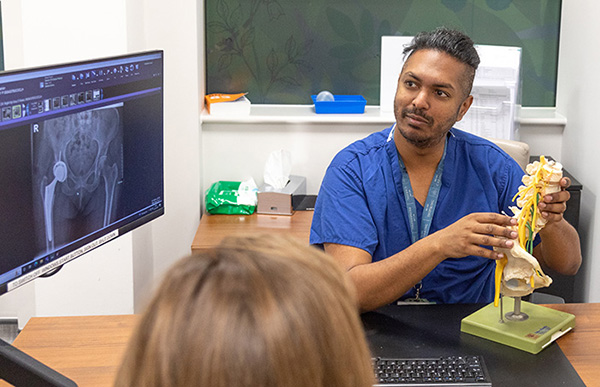
Mini posterior (piriformis-sparing) hip replacement
The posterior approach is the most widely used in the world, and the modern version bears little resemblance to the long incision of decades past. In the piriformis-sparing technique I use, the joint is reached through a short incision at the back of the hip and the piriformis tendon itself is preserved untouched. The only structures I detach are the obturator internus and gemelli, two small deep rotators, and at the end of the operation they are reattached strongly through the bone itself, a repair philosophy borrowed from the ligament reconstruction surgery we perform in athletes. The back of the hip ends the operation reinforced, not weakened. The gluteus medius and minimus, the muscles that power your walk, are never touched.
Its strengths: it is extensile, meaning it can be safely enlarged for complex or revision surgery; it gives the surgeon the clearest, most familiar view of the socket and femur; it does not disturb the nerve to the thigh's skin; and preserving the piriformis with a robust through-bone repair of the deep rotators has been shown to speed early recovery and improve early function compared with the standard posterior approach, with ten-year randomised follow-up confirming safety. The historical criticism was dislocation risk, and this is where the modern technique has changed the picture: sparing and reinforcing the deep tendons and repairing the capsule brings dislocation rates in published piriformis-preserving series down to well under one percent, a fraction of the old textbook figures.
Its honest weaknesses: the evidence for a stability advantage still slightly favours anterior-based approaches overall, and a poorly performed posterior approach, without tendon preservation and repair, deserves its old reputation.
Röttinger (anterior-based muscle-sparing) hip replacement
The Röttinger approach, described by Heinz Röttinger in Munich and known in the literature as the anterior-based muscle-sparing or ABMS approach, reaches the hip from the front and side, through the natural plane between the tensor fascia lata and gluteus medius. No muscle is cut at all. I trained in this approach over around three years, observing at the OCM centre in Munich where it was developed, training in cadaver labs in Germany and the UK under expert supervision, then performing it under proctorship before operating independently. It remains an approach offered by a small number of UK surgeons, and it is the anterior technique I use.
Its strengths: the stability of an anterior-based approach, with published data showing lower dislocation risk for anterior and anterolateral approaches; a rapid early recovery, with most suitable patients in my own series, around 95%, returning home within 24 hours, many without the traditional restrictions on bending or sleeping position; and, compared with the direct anterior approach, it sits one interval further from the lateral femoral cutaneous nerve, so the thigh numbness that troubles many DAA patients is much less common, the wound sits away from the groin crease, and the femur is easier to reach, all without the traction table or intra-operative X-ray that DAA typically requires.
Its honest weaknesses: access is a little more demanding than through a posterior approach, and I operate with two assistants rather than one, a resource few theatre teams routinely carry, which is part of why the approach remains uncommon in the UK. And like every anterior-based approach, its advantage is concentrated in the first weeks; by a year, outcomes converge across approaches. It is not the right route for every hip, which is exactly why I kept the posterior approach in my practice.
You can read how I perform it, and what recovery looks like, on my anterior hip replacement in London page.
At a Glance
Direct anterior approach (DAA)
The direct anterior approach reaches the hip from the front, between sartorius and tensor fascia lata. It is heavily marketed, and it is a good operation in experienced hands: genuinely muscle-sparing, stable, and quick to recover from.
Its honest weaknesses are better documented than its advertising suggests. The lateral femoral cutaneous nerve, which supplies feeling to the front and side of the thigh, runs directly through its territory; injury rates of around 31% appear in review data, and higher in some series, usually as numbness or tingling that settles but can persist. The incision sits close to the groin crease, in an area of skin folds and perspiration that is difficult to keep pristine, and some large studies report a higher rate of wound problems and infection with the direct anterior approach, although others find no difference; the fair summary is a small but real wound signal, particularly in patients with a higher BMI. Retraction on the femur can cause thigh discomfort in the early weeks. Exposure of the femur is the approach's technical weak point, it has a long learning curve with a recognised early-fracture signal, and it typically requires a traction table and X-ray screening in theatre.
Modified Hardinge (direct lateral) approach
The Hardinge approach reaches the hip from the side and involves detaching part of the gluteus medius tendon, which is repaired at the end of the operation. It has long been a workhorse of hip surgery, though it is less widely practised now, and it has real virtues: excellent visibility, versatility, and one of the lowest dislocation rates of any approach.
Its honest weakness is the muscle it goes through. Gluteus medius is the most important muscle the hip owns, central to walking, stability and balance, and although the tendon is repaired, recovery of the gait is slower, imaging studies show more lasting damage to the muscle than with muscle-sparing routes, and a proportion of patients are left with a persistent limp or weakness if the repair stretches or fails. My view, and the reason my own practice is built on the two approaches above, is simple: where a choice exists, choose an approach that does not violate gluteus medius at all. For certain hips, stiff, scarred, osteoporotic or badly deformed, the lateral approach is still the right and safest answer, and I say so when it is.
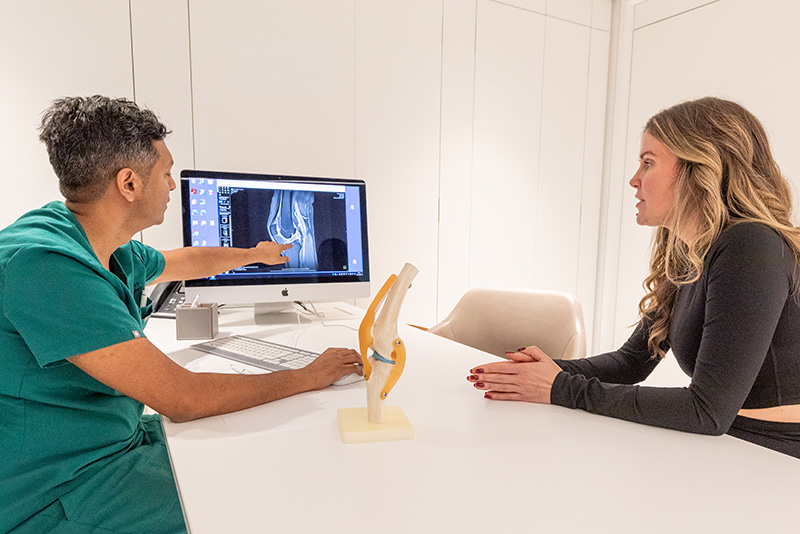
Anterior or posterior: the honest comparison
Between the two approaches I perform, here is what the evidence and my own practice actually show. Anterior-based surgery is potentially more stable, and in the first one to four days it is often slightly ahead: patients tend to come off walking aids and stop painkillers marginally sooner, a pattern confirmed in randomised trials of anterior versus posterior surgery. The anterior trade-offs are equally real: some studies show a higher risk of wound problems and infection, because the incision lies nearer the groin, an area of skin creases and perspiration; the possibility of nerve-related thigh numbness; and early thigh discomfort from the retraction the approach requires, all less pronounced with the Röttinger route than with DAA but not absent.
Between two and six weeks the gap closes, in the published trials and in my own patients alike, and by about a year it has disappeared. Done well, both operations in my hands mean going home the next day and a full recovery in four to six weeks. That sentence carries the real message of this page: "done well" is doing more work than "anterior" or "posterior".
The four approaches at a glance
Every claim in this table is expanded, with its caveats, in the sections above.
| Mini posterior (piriformis-sparing) | Röttinger (anterior-based muscle-sparing) | Direct anterior (DAA) | Modified Hardinge (lateral) | |
|---|---|---|---|---|
| How the hip is reached | Short incision at the back of the hip | From the front and side, through the natural plane between tensor fascia lata and gluteus medius | From the front of the hip | From the side of the hip |
| Muscle handling | Piriformis preserved; two small deep rotators detached and reattached strongly through bone; the walking muscles are never touched | No muscle is cut at all | Works between muscle planes at the front | Part of the abductor muscles is detached and repaired |
| Dislocation risk | Well under one percent with the modern repair technique | Lower for anterior-based approaches in published data | Lower for anterior approaches in published data | Traditionally low |
| The thigh’s skin nerve | Not in the surgical field | Lies away from the working plane | Numbness of the outer thigh appears in around 31 percent in review data | Not typically affected |
| Getting home | Next-day discharge is common with modern rapid-recovery care | Around 95 percent of suitable patients in my own series return home within 24 hours | Next-day discharge is common with modern rapid-recovery care | Usually a slightly longer stay while the repair is protected |
| Complex and revision surgery | The approach can be safely extended, which is why it remains the world’s workhorse | Suitability is assessed patient by patient | Less easily extended | Used selectively |
Rapid recovery hip replacement: what actually makes it rapid
Rapid recovery is a system, not an incision. The approach contributes, but so do the things patients rarely ask about: modern anaesthesia with local infiltration, getting you standing and walking on the day of surgery, no drains or drips left in overnight, strong muscles built before the operation rather than after it, and a surgeon doing a technique he performs every week rather than occasionally. When those pieces are in place, next-day discharge and a four-to-six-week recovery are the norm for suitable patients in my practice, by either approach. When they are not, no incision will rescue the result.
So which approach should you have?
The one that fits your hip. I use the Röttinger approach for most straightforward hips in patients who want the fastest possible early recovery and freedom from precautions. I use the mini posterior piriformis-sparing approach where the anatomy, previous surgery, bone quality or complexity favour it, and for hips that may need more extensile access. Some hips, stiff, scarred, osteoporotic or significantly deformed, are best served by other routes, and I say so when they are. The point of offering more than one approach is precisely that the recommendation follows the examination, not the other way round.
If you are weighing up hip replacement, or you have been told you need one and want a second opinion on the approach, that conversation is what a consultation is for. You can book an appointment online, call my team on 0207 859 4016, or email admin@ortholongevity.co.uk.
Underneath the question of approach sits a larger truth about how I practise. No two patients I meet with hip arthritis are alike, even when their X-rays are, so no two receive the same approach, the same operation or the same pathway to it. Your weight, your general health, your anatomy, your family history, your eating habits, your state of mind and the shape of your week all change what the right plan looks like, which is why the OrthoLongevity approach is built around you rather than around a protocol. And it is built realistically. I know how hard it is to change habits around children, caring for others and work that does not pause, because I juggle those same things myself, and I was not always someone who prioritised his own health. The plan that works is the one that fits your actual life, and that is the one we will build together.
Frequently Asked Questions
No approach is best for every patient. Anterior-based approaches offer slightly better stability and a faster first few days; a modern piriformis-sparing posterior approach offers outstanding versatility with a dislocation rate a fraction of the historical figure. Between two and six weeks the published trials show the difference fading, and by a year none remains. The surgeon’s skill with their chosen approach matters more than the approach itself.
Anterior surgery is often ahead in the first days and carries a lower dislocation risk in published data, but it also carries a slightly higher risk of wound problems and infection, because the incision lies nearer the groin, along with possible nerve-related thigh numbness and early thigh discomfort. In my practice, where both are done as modern muscle-sparing operations, the difference fades between two and six weeks, exactly as the published trials describe.
In my practice, patients walk on the day of surgery with either approach, and most suitable patients go home the next day. In my Röttinger series around 95% of suitable patients are home within 24 hours, many without traditional hip precautions.
For most of my patients, four to six weeks to feel fully recovered for daily life, with either approach, and improvement continuing for months afterwards. Recovery depends as much on the muscles you bring to the operation as on the operation itself, which is why preparation is part of my pathway.
A refinement of the posterior approach in which the piriformis and the other deep stabilising tendons are preserved rather than detached, and the capsule is repaired. Published series and a ten-year randomised follow-up show faster early recovery and dislocation rates well under one percent.
Not with the approaches I use. Both the Röttinger and the mini posterior approach are performed on a standard operating table without intra-operative X-ray, which the direct anterior approach typically requires.
Anterior-based approaches tend to give a quicker, more comfortable first few weeks and a lower dislocation risk, with fewer precautions to follow. Posterior approaches give the surgeon excellent access, suit complex and revision hips, and have a long track record. By one year results converge, so the right choice depends on your hip, your anatomy and your surgeon's experience.
Often not. Many suitable patients having a Röttinger hip replacement do not need the traditional restrictions on bending, low chairs, sleeping position or crossing the legs. Precautions are more commonly advised after a posterior approach in the early weeks.
With the Röttinger approach the scar is a short incision over the front and outer side of the hip, rather than at the back of the buttock. It sits further out from the groin than a direct anterior incision, which keeps it away from the skin crease.
References
Bertin KC, Röttinger H, Clin Orthop Relat Res 2004. Sheth D et al, Clin Orthop Relat Res 2015. Takada R et al, J Orthop Sci 2018. Cheok GJW and Moo IH, Arthroplasty Today 2024. Gustke KA, CCJR 2018, 1,308-case ABMS series. Direct anterior versus posterior approach multicentre randomised trial, Can J Surg 2020. Umbrella review of meta-analyses of randomised trials, Orthopedic Reviews 2023. Periprosthetic infection by approach, systematic review and meta-analysis, Bone Joint J 2022. Hanly RJ et al, the SPAIRE technique, Hip Int 2017. Piriformis-sparing versus standard posterior approach, ten-year follow-up of a randomised controlled trial, J Arthroplasty 2018. Piriformis preservation update, EFORT Open Reviews 2025.
Why Choose OrthoLongevity?
At OrthoLongevity, we deliver care built on innovation, compassion and clinical excellence. Led by Dr Arj Imbuldeniya, our clinic uses advanced therapies within our holistic Ortholongevity™ approach to help patients regain mobility and improve their quality of life. With access to the latest technologies and a dedicated, compassionate team, we focus on finding the right treatment for every individual.
Patient Reviews
What Our Patients Say
Verified Doctify reviews from patients treated by Dr Arj Imbuldeniya at OrthoLongevity.