
Request an appointment
Reserve your spot with our team in just minutes.
Other Knee Treatments
Partial Knee Replacement in London
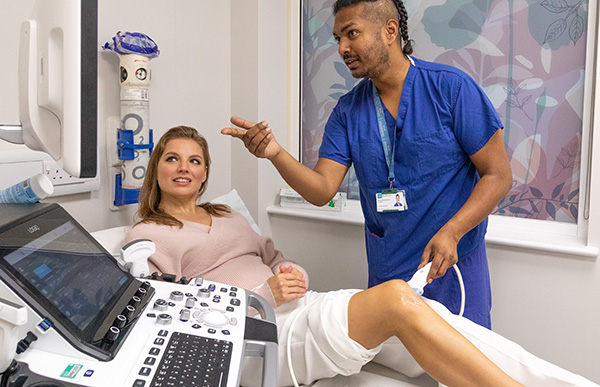
Dr Arj Imbuldeniya performs robotic-assisted partial knee replacement, also called partial knee resurfacing, for the right patients. It resurfaces only the worn compartment of the knee, medial, lateral or patellofemoral, and keeps the rest of the joint and your own ligaments intact. For a knee that only needs a partial, it means a faster, more natural-feeling recovery than a total replacement.
Free 60-second assessment
How old are your knees?
Your knees have a biological age, and it is often not the age on your passport. Of the people who have taken this test, 55 per cent found their knees were older than they are, and one in eight by ten years or more. Sixty seconds, free, and you get one number and the single change that would take the most years off it.
Find my Knee Age, free →The operation that keeps most of your knee
Not every arthritic knee needs a whole new joint. When the wear is confined to one part of the knee, replacing the entire thing removes healthy bone and healthy ligaments that were doing their job perfectly well. A partial knee replacement does the opposite. It resurfaces only the worn compartment and leaves everything else alone, including the cruciate ligaments that give your knee its sense of position and control. Done in the right knee, patients often tell me it does not feel like a replacement at all. The skill is not in doing the operation. It is in knowing which knee should have it.
What is a partial knee replacement?
The knee has three compartments: the inner (medial), the outer (lateral) and the one behind the kneecap (patellofemoral). Arthritis often begins in just one of them. A partial knee replacement resurfaces that single worn compartment with a small, precisely fitted implant, while the healthy cartilage, bone and ligaments in the rest of the joint are preserved. Less is removed, less is disturbed, and the knee that is left is largely your own.
Medial, lateral and patellofemoral resurfacing
There are three partial replacements, matched to where your arthritis actually is. A medial partial resurfaces the inner compartment, the most common site of isolated wear. A lateral partial addresses the outer compartment. A patellofemoral replacement resurfaces the joint behind the kneecap, the right answer for isolated kneecap arthritis that has genuinely run out of other options. Choosing correctly between them, and confirming the rest of the knee is healthy enough to keep, is the heart of the assessment. You can read more about kneecap problems on the kneecap pain and instability page.
At a Glance
Partial or total: which is right for you?
This is the question that matters, and it cuts both ways. Give a partial to a knee with widespread arthritis and it will fail, because the compartments you left behind keep wearing. Give a total to a knee that only ever needed a partial and you have taken away healthy structures for nothing. I have no fixed preference between the two operations. I have a fixed preference for the right one, which is why the assessment, your imaging, your examination, the pattern of your wear, matters more than any surgeon’s favourite technique. Where a whole-joint replacement is the honest answer, I perform robotic total knee replacement too.
Robotic precision, because it matters more here
Accuracy is decisive in a partial replacement, because a small implant has to sit in exact harmony with your own healthy joint around it. I use robotic-assisted planning and placement, MAKO or CORI, to position the implant to a fraction of a millimetre against a plan built from your own anatomy. The robot does not perform the operation. I do. It makes precise placement reproducible, which in partial knee surgery is exactly where longevity comes from.
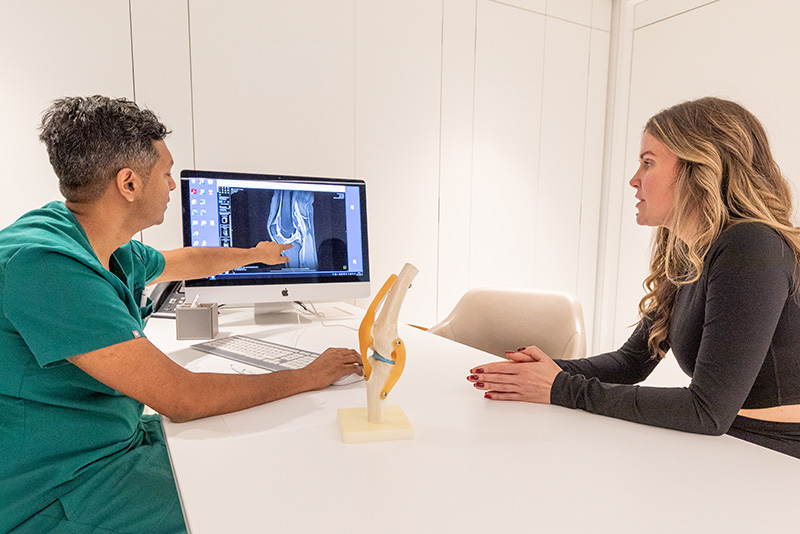
Before surgery is even on the table
Most arthritic knees I see never reach an operating theatre, and that is not an accident. Structured strength work, load management, weight where it is relevant, and the right injection at the right time can hold a knee comfortably for years. Surgery, partial or total, is for the knee that has genuinely passed that point. You can read how that is sequenced on the knee arthritis page.
When a partial is not the answer
Honesty runs both ways here. If your arthritis affects more than one compartment, or your ligaments are not intact, a partial will let you down and I will tell you so rather than sell you a smaller operation that will not last. Equally, if your knee is not yet bad enough to need any replacement, I will tell you that too. The goal is the right thing at the right time, not the newest thing.
Frequently Asked Questions
It resurfaces only the worn part of the knee and leaves the rest, including your own ligaments, untouched. Because most of the joint is preserved, many patients say it feels more like their natural knee than a total replacement does.
It depends on where the arthritis is and how much of the knee it affects. Wear confined to one compartment, with the rest of the joint healthy and the ligaments intact, is the ideal picture. I assess this carefully, because putting a partial into the wrong knee fails, and offering a total to a knee that only needed a partial takes away more than it should.
A total replacement resurfaces the whole joint; a partial resurfaces only the damaged compartment and keeps the healthy bone and the cruciate ligaments. When a knee genuinely only needs a partial, it usually recovers faster and feels more natural. When the arthritis is widespread, a total is the honest answer.
Yes. I use robotic-assisted planning and placement (MAKO or CORI) for partial knee replacement, because accurate positioning matters even more when you are resurfacing a single compartment alongside your own healthy joint.
Book a consultation and bring your imaging. I will tell you honestly whether a partial, a total, or no operation at all is the right answer for your knee. Call 0207 859 4016 or email admin@ortholongevity.co.uk.
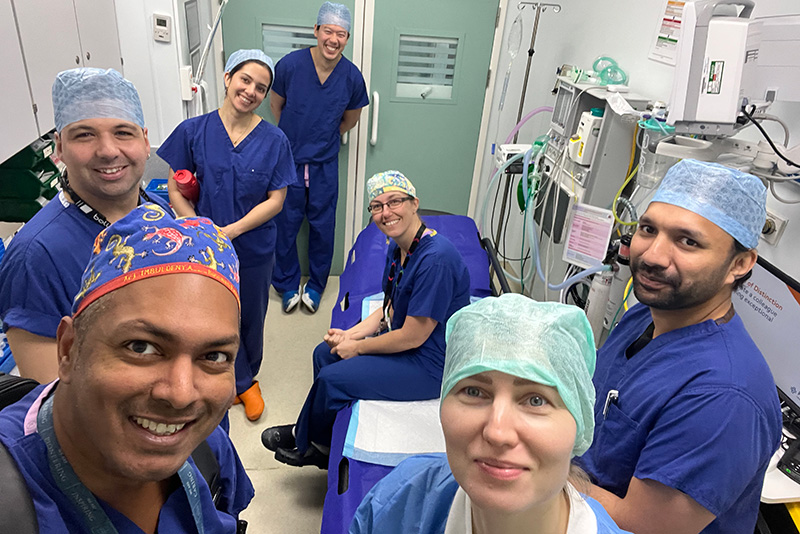
Why Choose OrthoLongevity?
At OrthoLongevity, we deliver care built on innovation, compassion and clinical excellence. Led by Dr Arj Imbuldeniya, our clinic uses advanced therapies within our holistic Ortholongevity™ approach to help patients regain mobility and improve their quality of life. With access to the latest technologies and a dedicated, compassionate team, we focus on finding the right treatment for every individual.
Patient Reviews
What Our Patients Say
Verified Doctify reviews from patients treated by Dr Arj Imbuldeniya at OrthoLongevity.