
Request an appointment
Send a request and Kelly or Louise will contact you to confirm a time. We aim to respond within one working day.
Other Knee Treatments
MAKO Robotic Kneecap Replacement in London
Patellofemoral joint replacement for arthritis behind the kneecap, preserving the healthy parts of your knee.
I am Dr Arj Imbuldeniya, a consultant knee surgeon in London. When arthritis is confined to the joint behind the kneecap, I can replace that one worn surface and leave the rest of your knee as it is, and I plan and carry out the operation with the MAKO robotic system at The Lister Hospital in Chelsea.
Written and medically reviewed by Dr Arj Imbuldeniya, Consultant Orthopaedic Knee and Hip Surgeon. Last reviewed 17 November 2026. The studies behind this page are listed at the end.
At a glance
Kneecap replacement at a glance
| Who it is for | Arthritis behind the kneecap, with healthy cartilage in the main weight-bearing parts of the knee |
|---|---|
| The operation | MAKO robotic-assisted patellofemoral joint replacement, using the Restoris patellofemoral implant |
| Before surgery | A CT scan of your knee, used to plan the operation |
| Hospital stay | Normally one night at The Lister Hospital, Chelsea |
| Crutches | For comfort only |
| Driving and desk work | Driving after about two weeks, work from home after one to two weeks |
| Guide price | £19,396 all-in, covering the hospital stay, the implant, my fee, the anaesthetist’s fee, the planning CT scan, your pre-assessment, X-rays after the operation and your first follow-up |
What is a kneecap replacement?
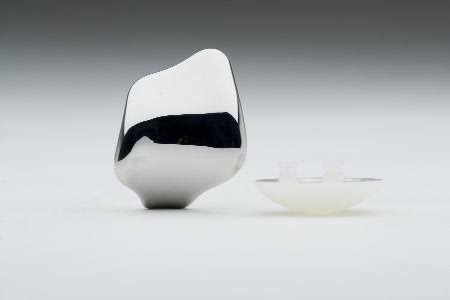
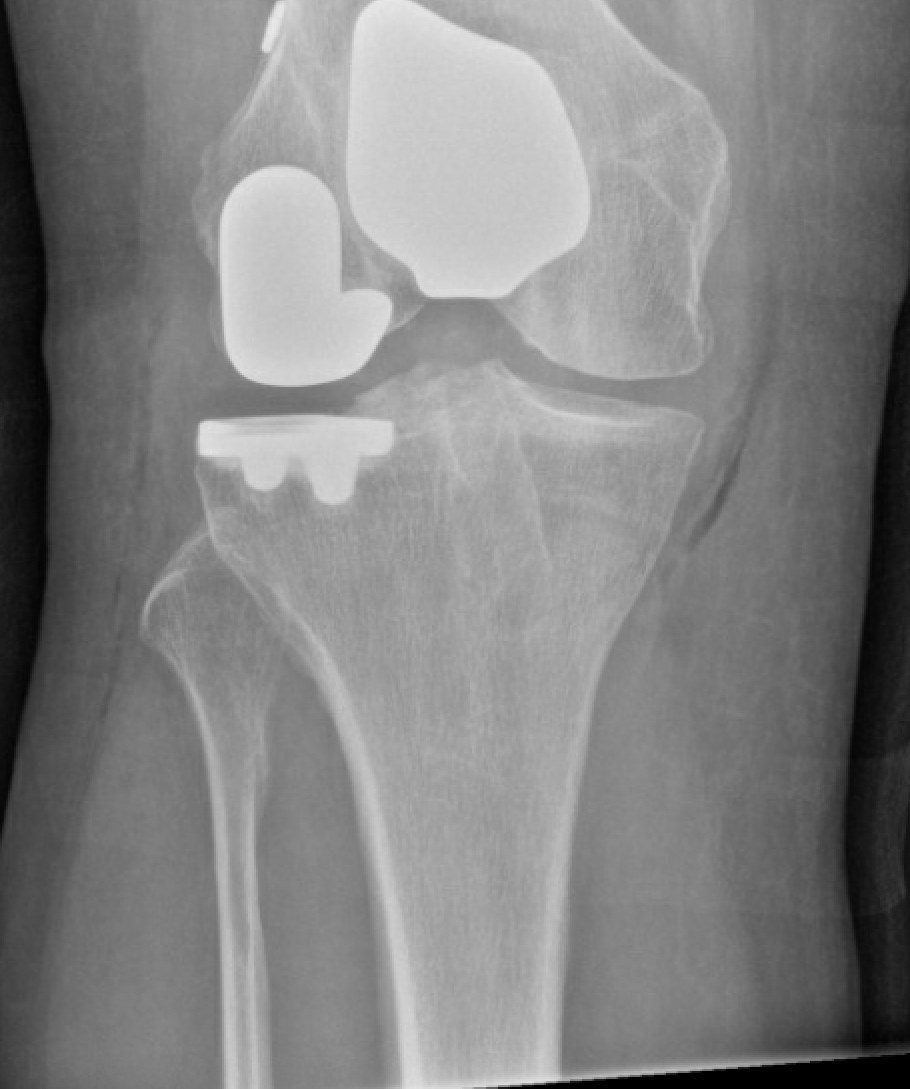
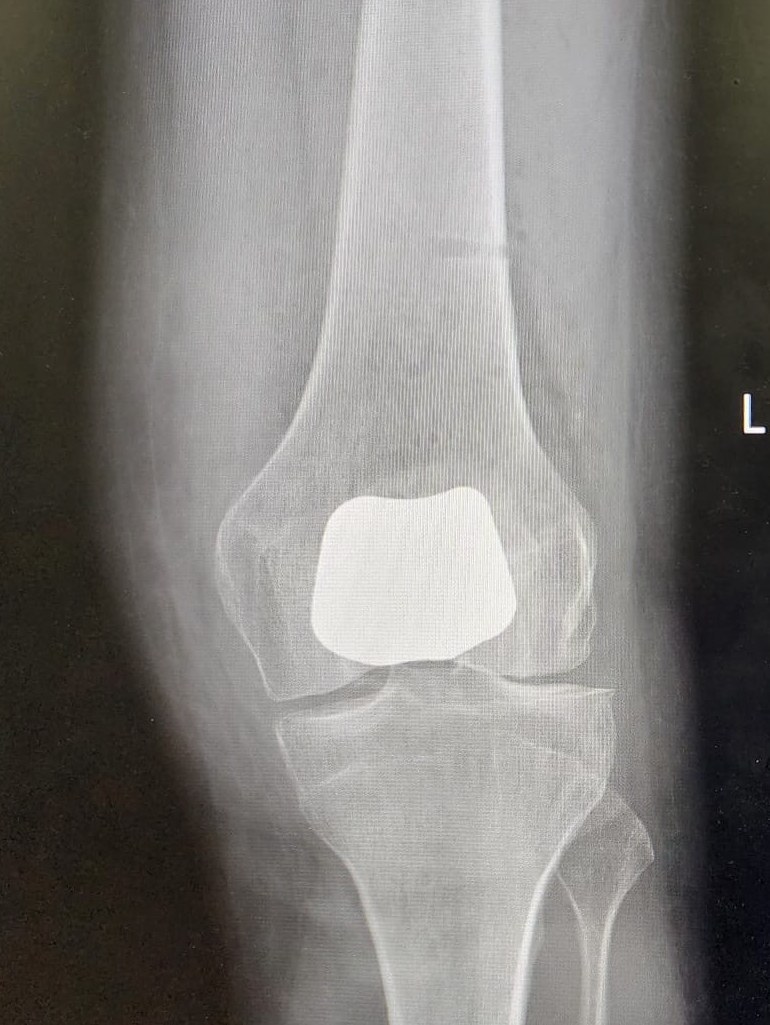
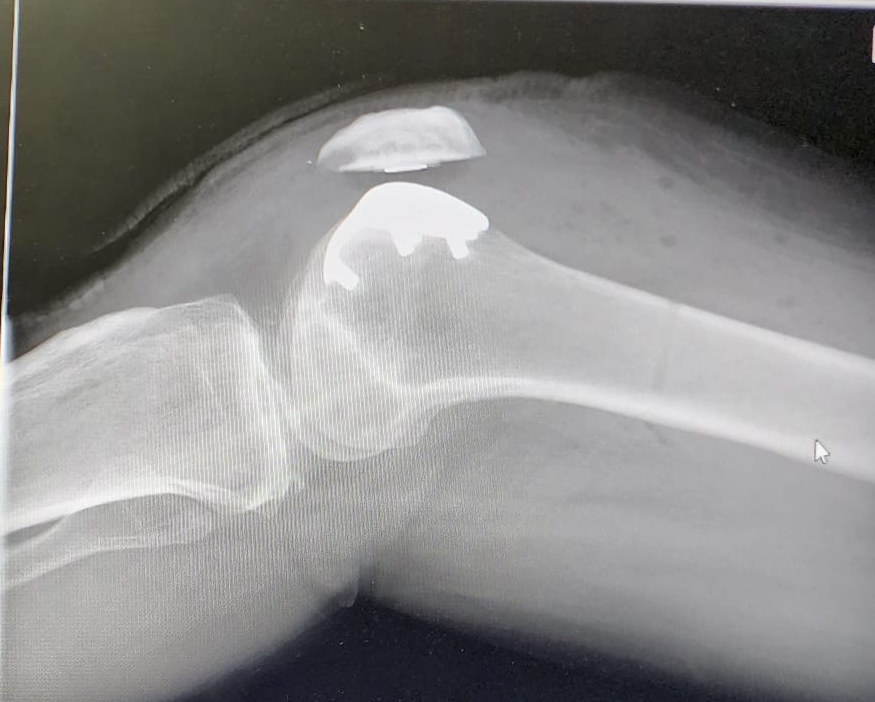
Your knee has three compartments: the inner side, the outer side and the joint between the kneecap and the groove it runs in at the front of the thigh bone, which is called the trochlea. A kneecap replacement, or patellofemoral joint replacement, resurfaces only that front compartment. The worn groove is replaced with a shaped metal component and the back of the kneecap with a plastic button, while your own ligaments and the inner and outer compartments are kept.
Who does it suit, and who needs a total knee replacement?
It suits people whose pain comes from the front of the knee, typically on stairs, on rising from a chair and when squatting or kneeling, and whose X-rays and MRI scan show wear behind the kneecap with the rest of the knee in good condition. In the published robotic series around three in four patients were women, with average ages of 57 to 63 [2], [3].
I do not normally offer it by itself if the inner or outer compartment, where the thigh bone meets the shin bone, is also arthritic. In some younger patients I can combine it with a partial replacement of that compartment, which can work very well for people who want to keep the ligaments of their own knee.
I perform total knee replacements too. They are very common operations, and when there is significant structural change in the knee, the patient is a little older and arthritis affects every part of the joint, a total knee replacement can be a very good solution. It is a bigger operation, though: the anterior cruciate ligament is always removed and the posterior cruciate ligament often is too, along with cartilage that may still be healthy. In my experience people are happiest with a total knee replacement when they really need one, so if you are fairly young, or large areas of your knee are in good condition, I would rather preserve your own tissue where I can.
I see the mistake made in both directions: some people with arthritis only behind the kneecap are offered a total knee replacement, and others are told for years that nothing can be done. Many of the patients I treat for this are women who have had kneecap instability or tracking problems in the past, and where the anatomy needs it I combine the replacement with a procedure to realign the kneecap.
Why the shape of your groove matters
No two trochleas are the same. Many people with kneecap arthritis have a shallow or uneven groove, known as trochlear dysplasia, and often a kneecap that has tracked towards the outside of the knee for years. The new component has to sit at the right depth and rotation for your knee, because that is what guides the kneecap as the knee bends.
How I plan and carry out the operation with MAKO
Before surgery you have a CT scan, which is used to build a three-dimensional model of your own knee bones. I plan the position of the trochlear component on that model, to your anatomy, before you come into hospital. In theatre the robotic system reads the same model, and the robotic arm keeps the bone preparation inside the boundary I planned. I resurface the back of the kneecap in almost every case, using an asymmetric Triathlon patella component.
Robotic or conventional: what the evidence shows
I use the robot because it lets me plan to your anatomy and then carry out that plan accurately. I will not tell you it guarantees a better result, because the evidence does not show that. In the Australian joint registry, 669 robotic and 1,481 conventional kneecap replacements needed redoing at about the same rate by six years, 12.7% against 11.6% [1]. A pooled analysis of eight studies found fewer complications and reoperations after robotic surgery, but those studies were not randomised, so the comparison is not a fair test [4]. Early results from robotic surgery are encouraging: in a series of 112 knees, about 97 in 100 had not been revised at four years, although about one patient in five was not satisfied [2].
How it differs from a MAKO partial knee replacement
A MAKO partial knee replacement resurfaces the inner or the outer compartment, where the thigh bone meets the shin bone. A kneecap replacement resurfaces the front compartment only. The planning scan and the robotic system are the same; the implant and the part of the knee being treated are different.
Risks, and how long it lasts
The risks include infection, blood clots, stiffness, continued pain at the front of the knee and a kneecap that does not track well. You should also know that kneecap replacements are redone more often than total knee replacements: the UK National Joint Registry reported revision rates around five times higher at 10 and 18 years [5]. The commonest reason is not the implant failing but arthritis developing in the rest of the knee, which accounted for 38% of failures in one review and 46% of the late ones [6]. That is why choosing the right knee matters more than the technology, and why I look closely at the other compartments before recommending it. If that does happen later, the kneecap replacement can be converted to a total knee replacement.
Recovery after kneecap replacement
Most people stay in hospital for one night. Crutches are for comfort only, and there is no restriction on how far you bend the knee. You can normally drive after about two weeks and work from home after one to two weeks. A manual or physical job normally takes 10 to 12 weeks, once the leg is strong enough and you have worked through your physiotherapy, and a return to sport normally takes about three months.
Watch and read more
- Video: Told You Need a Knee Replacement? A Knee Surgeon's Second Opinion
- Essay: I Did Three Operations Where One Might Have Done. Here's the Honest Maths.
More on my YouTube channel and in The Ortholongevity Journal.
Pain at the front of your knee?
Bring your X-rays and scans, or start from scratch. Either way you will leave with an honest answer about whether a kneecap replacement, a different operation or no operation is right for your knee. Consultations with Dr Arj Imbuldeniya are in Mayfair, Kensington, Chiswick and Brentford, and the operation is carried out at The Lister Hospital in Chelsea.
Kneecap Replacement Cost in London
As a guide, a MAKO robotic kneecap replacement with me at The Lister Hospital costs £19,396 all-in, covering the hospital stay, the implant, my fee, the anaesthetist’s fee, the planning CT scan, your pre-assessment, X-rays after the operation and your first follow-up. A new consultation is £350, and you receive a written estimate with the exact figure before anything is booked. Every fee I charge is on my pricing page.
Frequently Asked Questions
Yes. It replaces one of the three compartments of the knee, the joint behind the kneecap, and keeps the other two and your own ligaments. Its medical name is patellofemoral joint replacement.
Most people stay one night in hospital and use crutches for comfort only. Driving is normally possible after about two weeks, work from home after one to two weeks, a manual job after 10 to 12 weeks and sport after about three months.
As a guide, £19,396 all-in at The Lister Hospital, covering the hospital stay, the implant, the surgeon’s and anaesthetist’s fees, the planning CT scan, your pre-assessment, X-rays after the operation and your first follow-up. You receive a written estimate before anything is booked.
The operation is carried out at The Lister Hospital in Chelsea. Consultations are in Mayfair, Kensington, Chiswick and Brentford. Request an appointment online, call 0207 859 4016 or email admin@ortholongevity.co.uk.
Why Choose OrthoLongevity?
I assess you myself, guide injections in clinic with ultrasound, and can operate when an injection is no longer the right answer, so the advice you get is not tied to one treatment. Whatever we decide, the plan is built around you: your weight, your strength, your sleep, your work and the people who rely on you.
References
- Saidy et al. Robotic versus non-robotic patellofemoral arthroplasty, Australian registry. J Arthroplasty 2026;41(2):423-9. doi.org/10.1016/j.arth.2025.06.035
- Clement et al. Robotic patellofemoral arthroplasty, multicentre cohort of 112 knees. Bone Joint J 2026;108-B(2):169-76. doi.org/10.1302/0301-620X.108B2.BJJ-2025-0439.R1
- Williamson et al. Knee Surg Sports Traumatol Arthrosc 2026;34(10):3646-54. doi.org/10.1002/ksa.70301
- D’Andrea et al. Robotic versus conventional patellofemoral arthroplasty, systematic review and meta-analysis. Arch Orthop Trauma Surg 2026;146(1):44. doi.org/10.1007/s00402-025-06166-3
- National Joint Registry, 18th Annual Report, 2021, executive summary. reports.njrcentre.org.uk/2021/AR-Executive-Summary
- van der List et al. Why do patellofemoral arthroplasties fail today? A systematic review. Knee 2017;24(1):2-8. doi.org/10.1016/j.knee.2015.11.002
Patient Reviews
What Our Patients Say
Verified Doctify reviews from patients who have received treatment for knee conditions under the care of Dr Arj Imbuldeniya at OrthoLongevity.