
Request an appointment
Reserve your spot with our team in just minutes.
Other Knee Treatments
Does PRP Help a Meniscus Tear Heal? What the Evidence Says
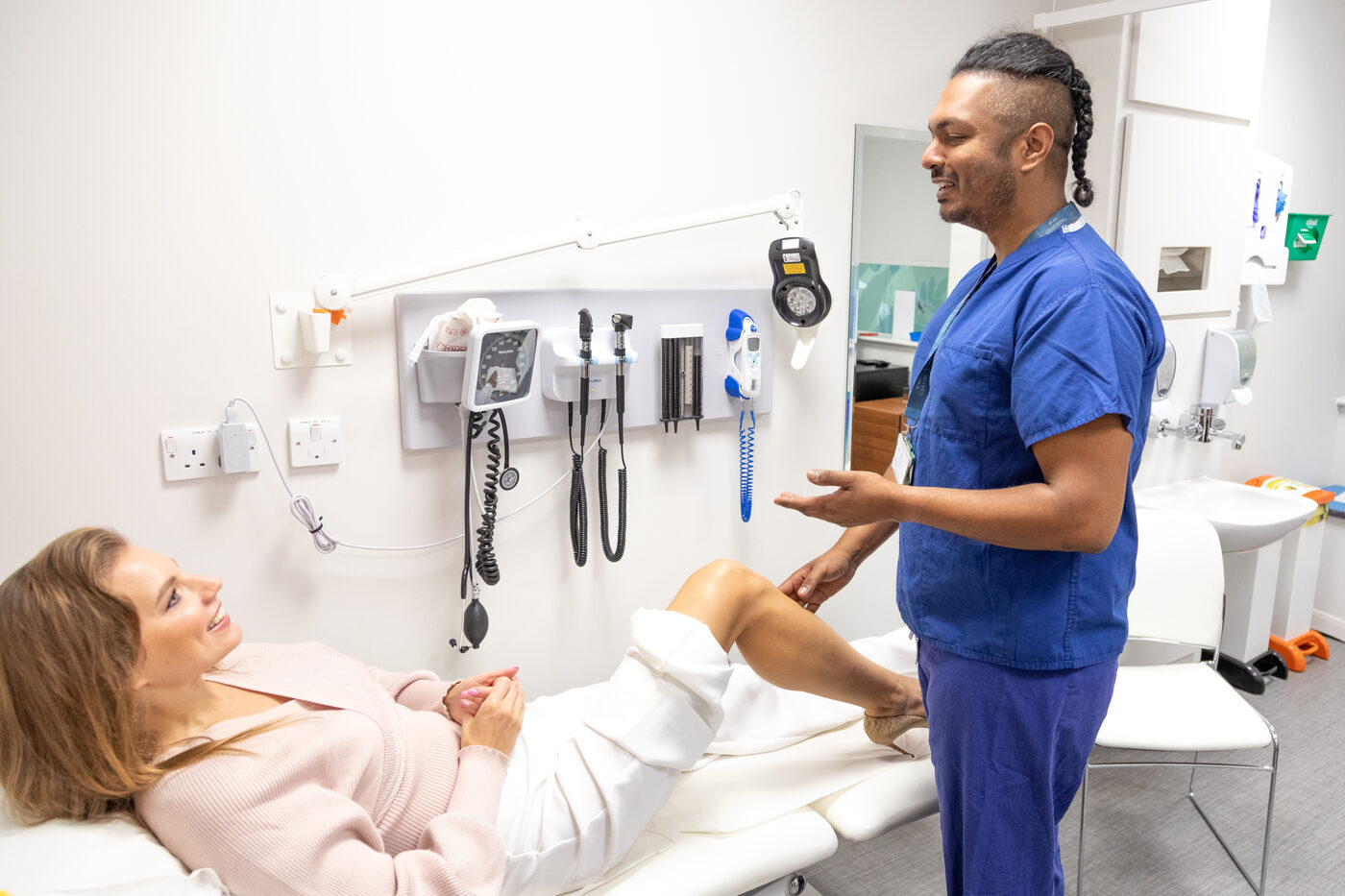
If you have been told you have a meniscus tear, you will want to know whether anything can help it heal, and whether an injection might save you an operation. I am asked this most weeks in clinic, so here is my answer, with the studies behind it.
PRP stands for platelet-rich plasma. We take a small sample of your own blood, spin it to concentrate the platelets, and place that concentrate where healing is needed. Platelets carry growth factors, which are the chemical signals that start repair. The idea makes sense. What matters is whether it works in a real knee, and the answer depends on the type of tear you have.
The short answer
PRP and meniscus tears at a glance
- A PRP injection on its own will not knit an unstable or displaced tear back together. Those tears need stitching.
- When a meniscus is repaired on its own, the studies suggest PRP may lower the chance of the repair failing. The evidence is encouraging, but it is not settled.
- When a meniscus is repaired at the same time as an ACL reconstruction, PRP has not been shown to add anything.
- For worn, degenerative tears, one small trial found less pain and fewer patients going on to keyhole surgery when PRP was placed into the tear.
- For bone marrow concentrate (BMAC) and micro-fragmented fat (MFAT), the human evidence in meniscus tears is early and small.
Why a meniscus struggles to heal
Each knee has two menisci, the C-shaped cushions that spread load between the thigh bone and the shin bone. Only the outer third has a blood supply. The inner two thirds have almost none, and tissue without blood struggles to heal, because blood is what carries the repair cells and growth factors in.
That is why the position of your tear matters so much. A tear at the outer rim can heal well once it is held still with stitches. A tear in the inner part often cannot. It is also why I try to repair a meniscus rather than remove it wherever the tear allows. The meniscus protects the joint surface, and a knee that keeps its meniscus tends to do better over the years.
PRP, bone marrow and fat are all attempts to solve the same problem. They bring healing signals to tissue that does not get enough of its own.
Can a PRP injection heal a meniscus tear without surgery?
For some tears it may help. For others it will not, and I would rather you knew that before paying for it.
The main study here is a randomised trial of 72 patients with long-standing degenerative tears (Kaminski, 2019). Everyone had the tear needled under guidance to make it bleed. Half also had PRP placed into the tear. The treatment failed in 48 per cent of the PRP group compared with 70 per cent without PRP, and 8 per cent of the PRP group went on to keyhole surgery compared with 28 per cent. That is a real difference. It is also one small trial from one centre, and nearly half the PRP group still did not get the result they wanted.
What PRP cannot do is hold a torn meniscus in place. If a piece of meniscus has flipped into the joint, if your knee locks or gives way, or if the root of the meniscus has pulled off the bone, the tear is mechanically unstable. No injection will fix that. It needs to be stitched, and sooner is better than later.
If your tear is a worn one in a knee that is starting to show arthritis, the first step is not surgery and usually not an injection either. It is strength. I ask every patient to follow the exercise programme I use myself, often with one of the physiotherapists I trust. If pain is still holding you back, high-dose PRP and the other knee injections are the next step, and I give those at Lanserhof at The Arts Club in Mayfair.
Does PRP help a meniscus repair heal?
This is where the evidence is most interesting, and where surgeons still disagree.
A randomised trial of 37 patients having a vertical tear stitched found that 85 per cent of repairs had healed at 18 weeks when PRP was added, compared with 47 per cent without it (Kaminski, 2018). A much larger study of 550 patients found fewer failures when PRP was added to a meniscus repair done on its own (Everhart, 2019).
When researchers pool the studies, the picture is less tidy. One pooled analysis of 9 studies and 1,164 patients found the odds of a repair failing were about a third lower with PRP (Li and Weng, 2022). Another, covering 837 patients, found no difference in failure rate or knee scores and concluded that PRP could not be recommended as routine (Migliorini, 2022). Neither found that PRP made patients feel or function better in the long run.
My reading is this. For a meniscus repaired on its own, there is a reasonable case that a biological boost improves the chance of healing, and very little downside, because it is your own blood. The studies do not agree, and I will not pretend they do. If you are having a repair with me, we will talk through whether it makes sense for your tear.
Why it matters whether your ACL is being reconstructed at the same time
Surgeons have known for years that a meniscus repair done alongside an ACL reconstruction heals more reliably than a repair done alone. The likely reason is simple. To reconstruct an ACL I drill tunnels in the bone, the bone bleeds into the joint, and that blood carries marrow cells and growth factors straight to the repair. The knee makes its own healing mixture.
This explains the pattern in the PRP studies. In the 550 patient study, PRP made no difference when the ACL was reconstructed at the same sitting, because the knee was already getting what it needed (Everhart, 2019).
It has also led to a simple technique for repairs done on their own, called marrow venting. The surgeon makes a few small holes in the bone inside the knee so that it bleeds in the same way. One study found that repairs done with marrow venting did as well as repairs done with an ACL reconstruction (Dean, 2017), and a randomised trial found better healing with venting than without (Kaminski, 2019). It costs nothing extra and uses your own biology, which is the kind of answer I like.
Do BMAC or MFAT help a meniscus tear?
BMAC is bone marrow concentrate. Marrow is drawn from your pelvis with a needle and concentrated. MFAT is micro-fragmented fat, a small amount of your own fat that is washed and broken into tiny clusters. Both carry repair cells and signalling molecules, and both are used far more for arthritis and cartilage than for meniscus tears. I explain how I use them on my BMAC page and my knee injections page.
For meniscus tears the evidence in people is thin. For BMAC, the human studies are small and none of the ones I rely on is a randomised trial. For MFAT, the main study is a pilot of 20 patients with worn tears and arthritis, where pain fell from about 5.5 to 2.2 out of 10 a year after an injection into the tear and the joint (Malanga, 2021). There was no comparison group, so we cannot say how much of that was the fat and how much was time, needling and rehabilitation. A randomised trial was set up to answer that, and it recruited three patients.
So these are options I will discuss with you when the rest of the knee gives a reason to use them, such as arthritis or a cartilage defect alongside the tear. I would not offer either as a treatment to heal a meniscus tear by itself.
What I recommend, and in what order
We don't stack treatments. We do the right things in the right order.
- Get the diagnosis right. I examine your knee, look at your MRI with you and work out which kind of tear you have, because that decides everything else.
- If the tear is unstable and repairable, repair it early, and give the repair the best biology we can on the day.
- If the tear is a worn one, build strength first. Many of these knees settle without any procedure.
- Use PRP or another biological treatment where the evidence and your knee both support it, as an addition to good care and never in place of it.
If an operation is the right answer, I use modern keyhole techniques designed to keep as much of your own meniscus as possible.
How my team and I look after you
You will not be handed a leaflet and sent away. My team and I look at the whole of you, not only the scan: your strength, your weight, your sleep, your sport and what you want your knee to do in ten years. We use every treatment available, we start with the least invasive one that has a fair chance of working, and we tell you plainly when something is unlikely to help.
If you would like to prepare, my knee recovery kit page lists what is worth having at home, and you can book an appointment when you are ready.
Not sure what your meniscus tear needs?
Book a consultation. I will examine your knee, go through your scan with you and tell you what I would do in your position.
PRP and Meniscus Tear Questions
Some can. Small, stable tears at the outer rim, where there is a blood supply, may heal or settle with time and strengthening. Tears in the inner part, and tears that are displaced or make the knee lock, generally do not heal without being stitched.
For an unstable or displaced tear, no. PRP cannot hold torn tissue together. For a worn, degenerative tear, one randomised trial found fewer patients went on to keyhole surgery after PRP was placed into the tear, so it can be a reasonable step before surgery once strength work has been tried.
If the repair is being done on its own, there is a reasonable case for a biological boost, although studies disagree. If your ACL is being reconstructed at the same time, the evidence shows no extra benefit, because the bone tunnels already bring healing cells into the knee.
No. PRP supports healing in tissue that is still there. It does not create new meniscus. If a large part of your meniscus has been removed and the knee is painful, there are other options, and I would need to examine you to advise.
PRP is made from your own blood, so allergic reactions are not expected. The knee can be sore and swollen for a few days afterwards. As with any injection into a joint there is a small risk of infection, which is why it is done under sterile conditions.
References
- Kaminski R, et al. Short-term outcomes of percutaneous trephination with a platelet rich plasma intrameniscal injection for the repair of degenerative meniscal lesions. Int J Mol Sci. 2019;20(4):856. doi:10.3390/ijms20040856
- Kaminski R, et al. A prospective, randomized, double-blind, parallel-group, placebo-controlled study evaluating meniscal healing, clinical outcomes, and safety in patients undergoing meniscal repair of unstable, complete vertical meniscal tears augmented with platelet-rich plasma. Biomed Res Int. 2018;2018:9315815. doi:10.1155/2018/9315815
- Everhart JS, et al. Platelet-rich plasma reduces failure risk for isolated meniscal repairs but provides no benefit for meniscal repairs with anterior cruciate ligament reconstruction. Am J Sports Med. 2019;47(8):1789-1796. doi:10.1177/0363546519852616
- Li Z, Weng X. Platelet-rich plasma use in meniscus repair treatment: a systematic review and meta-analysis of clinical studies. J Orthop Surg Res. 2022;17:446. doi:10.1186/s13018-022-03293-0
- Migliorini F, et al. Meta-analysis of PRP added to arthroscopic meniscal repair. J Orthop Traumatol. 2022;23. doi:10.1186/s10195-022-00630-1
- Dean CS, et al. Outcomes after biologically augmented isolated meniscal repair with marrow venting are comparable with those after meniscal repair with concomitant anterior cruciate ligament reconstruction. Am J Sports Med. 2017.
- Kaminski R, et al. Repair augmentation of unstable, complete vertical meniscal tears with bone marrow venting procedure: a prospective, randomized, double-blind, parallel-group, placebo-controlled study. Arthroscopy. 2019. doi:10.1016/j.arthro.2018.11.056
- Malanga GA, et al. Clinical evaluation of micro-fragmented adipose tissue as a treatment option for patients with meniscus tears with osteoarthritis: a prospective pilot study. Int Orthop. 2021;45(2):473-480. doi:10.1007/s00264-020-04835-z
Patient Reviews
What Our Patients Say
Verified Doctify reviews from patients who have received treatment for knee problems under the care of Dr Arj Imbuldeniya at OrthoLongevity.