
Request an appointment
Reserve your spot with our team in just minutes.
Other Knee Treatments
Knee Exercises After Injury or Surgery: Where to Start and What to Do Next
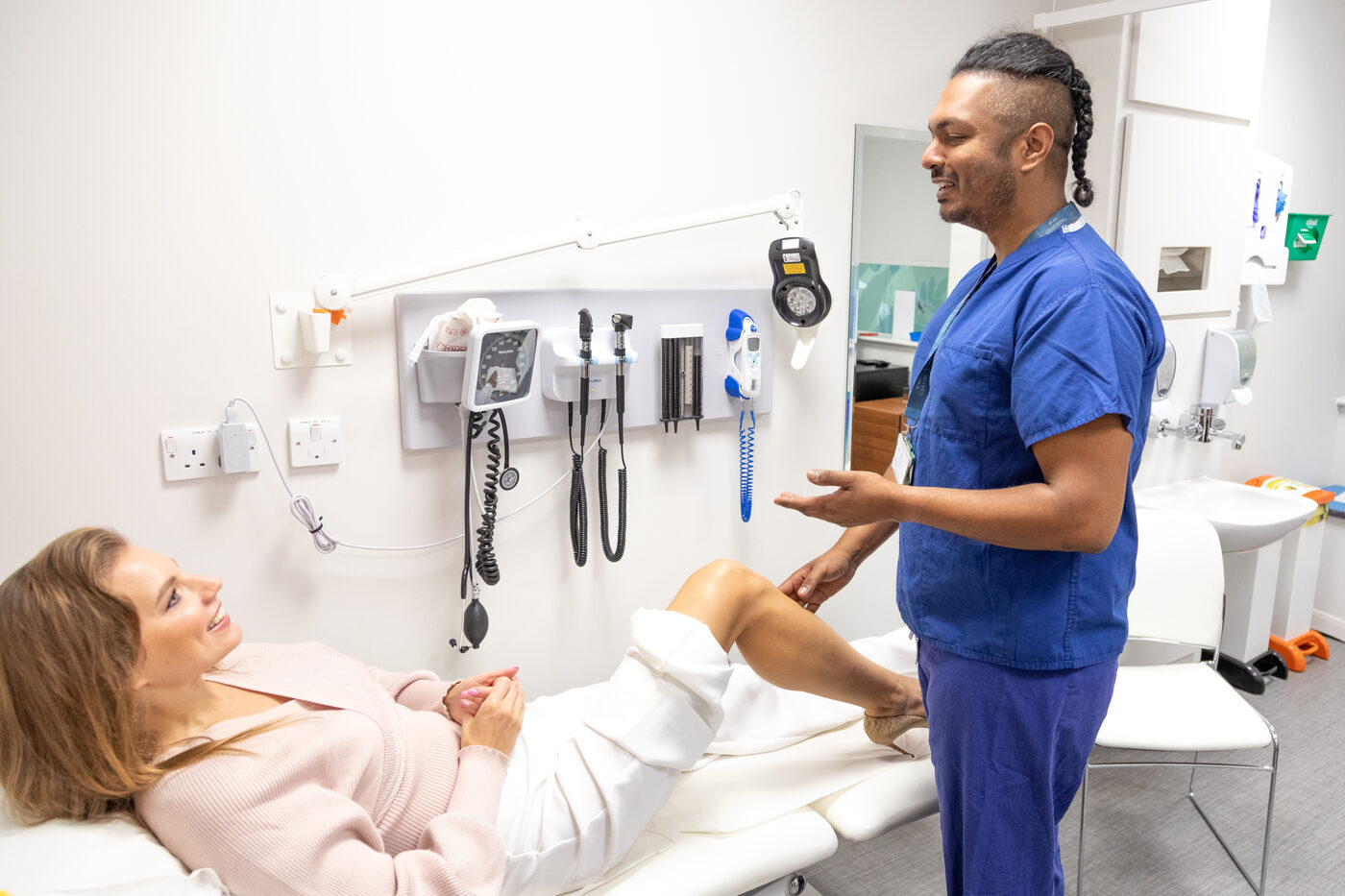
A knee injury or a knee operation is unsettling, and I know the real worry is usually not the knee itself but whether you will get back to the life you had. My team and I are here to get you there. This page sets out the exercises I ask my own patients to do, in the order that matters, starting with the one thing almost everyone misses, which is getting the thigh muscle to switch back on. Your physiotherapist and I will tailor the detail to you, and the limits set for your own operation always come first.
At a glance
- First priority: switch the thigh muscle back on and get the knee fully straight
- How often: little and often, several short sessions a day in the early weeks
- Equipment: none to begin with, then a gym
- Stage one: the first two weeks
- Stage two: weeks two to four
- Stage three: one gym session a week from weeks four to six onwards
- Stage four: running and sport when your strength tests say so
Start here: wake up your thigh muscle
After a knee injury or operation the thigh muscle at the front, the quadriceps, switches off. It is not weak because it has been damaged. It is weak because the nervous system stops sending it a proper signal, a reflex called arthrogenic muscle inhibition. A 2026 paper from the French group led by Sonnery-Cottet describes how this involves changes in the brain's movement circuits and not only in the knee itself. In my experience this inhibition holds people back more than the injury to the ligament, tendon or meniscus.
The answer is to target the muscle on purpose. Sit with your leg straight, look at your thigh, put a hand on it and think about tightening it so the kneecap moves up towards your hip. Hold for five seconds and let go. If nothing happens at first, keep trying, because the connection comes back with repetition and attention. Everything else on this page works better once that muscle is firing.
Stage one: the first two weeks, get the thigh muscle firing
The most important job in the first two weeks is to get the nerves and the thigh muscle firing again. After an injury or an operation the nervous system switches the thigh muscle off. It is called arthrogenic muscle inhibition, and until that muscle is contracting properly, nothing else works as well as it should. Everything below is aimed at that, and at getting the leg fully straight.
- Push the knee down into the bed. Lie or sit with your leg out straight. Press the back of your knee down into the mattress, as if you were squashing something underneath it. You should see and feel the muscle on the front of your thigh tighten. Hold for five seconds, relax, and repeat ten times. Do this every hour or two while you are awake.
- Pull your foot back towards you. With the leg straight, pull your toes and ankle up towards your shin, then push the knee down as above. Pulling the foot back helps the thigh muscle switch on and helps the knee go straight.
- Heel props. Put a rolled towel under your heel so there is nothing under the knee, and let the leg hang straight for a few minutes at a time. Gravity gently straightens the knee for you. Getting the leg fully straight is much easier in the first weeks than later.
- Straight leg raise. Tighten the thigh first, then lift the whole leg a few inches off the bed, keeping the knee locked straight, and lower it slowly. If the knee bends as you lift, the muscle is not ready, so go back to pushing the knee down.
- Heel slides. Slide your heel along the bed towards your bottom so the knee bends, as far as your operation allows, then slide it back out straight.
Ice and anti-inflammatories. Use lots of ice, and take anti-inflammatory tablets if they are safe for you. A swollen, sore knee keeps the thigh muscle switched off, so bringing the swelling down is part of the exercise, not an extra.
If the muscle will not fire. A muscle stimulator can help. It uses a small electrical pulse through pads on the thigh to make the muscle contract while you try to tighten it yourself. I explain how on my knee recovery kit page.
Stage two: strong on your feet, weeks two to four
From about week two to week four, once you are walking comfortably and the swelling is settling, the work moves to standing.
- Sit to stand. Up and down from a chair without using your hands, slowly.
- Mini squats. A shallow squat holding a worktop, weight even on both legs.
- Step ups. Onto a low step, leading with the affected leg, controlling the way down.
- Bridges. Lying on your back, knees bent, lift your hips.
- Calf raises. Up onto your toes and slowly down.
- Static bike. Low resistance at first, for movement more than effort.
I generally try to get people putting weight through the leg early and bending the knee early. There are exceptions, and I will tell you if you are one of them. Some meniscus repairs, mainly root repairs and radial repairs, can pull apart if you put weight on them too soon, so after a root repair I normally ask for six weeks of protected weight bearing. Some cartilage operations, such as an AutoCart cartilage transplant, need the new cartilage protected while it settles. And after some realignment operations, such as moving the bony attachment of the kneecap tendon for kneecap instability, I may limit how far you bend the knee for about two weeks.
Stage three: the gym programme I ask every patient to do
Once the early work is done, usually from somewhere between week four and week six, and carrying on through week twelve and beyond, and when I or your physiotherapist say each exercise is safe for your operation, this is the programme I ask every patient to do. It is the same programme I do myself.
- Romanian deadlift
- Hip abduction
- Hip adduction
- Glute hip thrust
- Leg press, seated, with the hips and knees bending to a right angle and no further
- Leg extension
- Hamstring curl, both legs together
- Calf raises
Leg press, and why I stop at a right angle. I prefer the leg press to a squat because you are seated and supported, which I think makes it safer. Let your hips and knees bend to a right angle and no further. In my view going deeper adds little and puts pressure on structures in the hip, such as the labrum, and in the knee, such as the meniscus. Stay at 90 degrees and add weight when you can.
Do not forget the muscles above and below the knee. The muscles around the hip and the calf matter as much as the thigh. And glutes does not only mean gluteus maximus. Gluteus medius, on the side of the hip, controls the leg when you land and when you walk up and down slopes, and the hip abduction machine is how you train it. It matters enough that in a Röttinger hip replacement I work between the muscles and do not cut it.
How to do it. Three to four sets of six to eight repetitions of each exercise, using both legs together. Choose a weight you can lift six to eight times with good form and no more. Spend your first two or three sessions on lighter weights while you learn the movements. The whole session takes 60 to 90 minutes, and once a week is all I ask.
Write it down. Log every session in an app or a notepad: the exercise, the weight, the sets and the repetitions. Each week, match what you did last time or add a little weight. That steady progression is what makes you stronger. I use an app called Gymverse for this.
My video on the gym exercises that protect your knees shows you what to do, and my video on why strength fixes knee pain explains why it matters.
Why the gym, why heavy and why once a week
Why the gym. I ask patients to go to a gym because, in my experience, bands and home exercises stop being heavy enough. Trials that compare elastic bands with weights over a few weeks find similar strength gains, so bands are a fair place to start, but you cannot keep adding load to a band the way you can to a leg press, and adding load is the point.
Why heavy, and why six to eight. A pooled analysis of 21 studies found that heavier weights build more strength than lighter ones, while muscle size can be built across a range of loads. Tendons are more particular: a review of 27 training studies found that they adapt to heavy loading far better than to light loading. Six to eight repetitions keeps the weight in that range.
Why once a week. In a randomised trial of adults aged 65 to 79, three sets of eight repetitions at a heavy load once a week produced the same strength gains over 24 weeks as the same session twice or three times a week. Once a week is also something people keep doing.
Why both legs together. A 2025 review found no difference in muscle growth between training one leg at a time and both together, and two-legged exercises let you lift more with better control.
What it does. Stronger muscles and tendons take load off sore joints, help you recover after an operation and put you in good shape before one. Across 25 trials, strength training cut sports injuries to less than a third.
What I see in clinic, and what I do myself
I have seen thousands of patients over the last decade as a consultant, and I barely see anyone who does these exercises regularly. I see people who are not very fit and do little, and I see people who are very fit but do everything else: running, football, padel, yoga, Pilates and dancing. Very few of them lift. In my experience, when someone tells me they do not like the gym, that is often why their knees and hips hurt.
I do this session myself once a week. It carried me through training for the London Marathon, and over the years it has settled pains in my right groin, my left calf and ankle and my left glute. I sometimes get a mild pain at the front of my right knee, and the leg extension, the exercise most people expect to hurt, is what settles it.
How much discomfort is acceptable
Some discomfort while you train, up to 3 or 4 out of 10, is fine. It means you are challenging the joint. A review of trials in long-standing joint and muscle pain found that exercise allowed to be a little painful did slightly better in the short term than exercise kept pain free. Often, when you come back and train over the next two to three weeks, that pain eases because you are fitter.
Rest feels better at first. Then, as you lose fitness, the pain creeps back, and it creeps back in ordinary activities, not only in sport. We all lose muscle with age, and women lose bone more quickly after the menopause, so doing nothing is not a neutral choice.
Stage four: running and sport
Running and sport come back when the leg is ready, not when the calendar says so. I want to see a quiet knee, full straightening, and strength in the operated leg close to the other side before you run. After an ACL reconstruction most of my patients are walking comfortably by about two weeks and jogging at three to four months, and a return to pivoting sport takes longer and is decided on strength and hop tests with your physiotherapist.
If you have a sore knee and have not had surgery
The same exercises apply. The NICE osteoarthritis guideline recommends exercise tailored to the person, such as local muscle strengthening and general fitness, for everyone with osteoarthritis, and it advises that joint pain may increase when you first start. Begin at stage two, build to stage three and give it three months of steady work before you judge it. If the knee is not improving, that is the point to be assessed properly.
What helps the work
Muscle is built from protein and effort together, so what you eat matters while you are doing this. My video on what to eat for knee pain and my page on strength training and nutrition set out the plan, and my knee recovery kit page covers the equipment that is worth having and the things you can skip.
A good physiotherapist makes every stage easier, and these are the knee physiotherapists in London I work with.
How much protein do you need alongside your exercises?
Exercise is the signal to build muscle and protein is the material it is built from, so the two belong together. As a simple guide, aim for 20g to 25g of protein at each meal, from foods such as chicken, fish, eggs, Greek yoghurt, beans, lentils and tofu, and it is worth knowing that Greek yoghurt and skyr have nearly double the protein of an ordinary yoghurt. Protein shakes are optional and can be a practical top up on a busy day. If you have kidney disease, please speak to your doctor before you increase your protein.
I have set out how much you need each day, and a fuller list of easy supermarket foods for meat eaters and vegetarians, on my knee and hip physiotherapists page, alongside the physiotherapists I work with.

When to stop and call us
Some soreness after exercise is expected and should settle within a day. Stop and contact us if you have calf pain or swelling, a hot, red or leaking wound, a fever, a knee that suddenly swells or gives way, or pain that is getting worse instead of better.
How my team and I look after you
You are not doing this on your own. I work alongside physiotherapists and a wider team so that your rehabilitation, your strength and what you eat are looked at together and not one at a time. We don't stack treatments. We do the right things in the right order.
That means the simpler, less invasive options come first: exercise, physiotherapy and, where they are right for you, injections. An operation is something I recommend when it is the right answer for your knee, not before it is needed and not after it should have been done. When surgery is the right answer, I use modern, precise techniques so that you get the most from it.
If you are not sure where you are on that path, book a consultation and we will work it out together. My Joint Health Programme page explains how the whole approach fits together.
Planning for knee surgery?
Book a consultation and we will plan the operation and the recovery together.
Knee Exercise Questions
Getting the thigh muscle firing. After knee surgery or injury the thigh muscle switches off through a reflex called arthrogenic muscle inhibition, so the first job is to sit with the leg straight, push the back of the knee down into the bed and hold for five seconds, ten at a time, many times a day.
Usually the same day or the next day, with thigh squeezes, ankle pumps and gentle bending within the limits set for your operation. Your physiotherapist will show you before you go home.
Little and often in the early weeks: several short sessions a day work better than one long one. Once you are in the gym, I ask for one session a week of 60 to 90 minutes: eight exercises, three to four sets of six to eight repetitions each.
Some discomfort, up to 3 or 4 out of 10, is fine and often eases over the next two to three weeks as you get fitter. Sharp pain, new swelling or pain that keeps getting worse is a reason to stop and get advice.
Most of my patients are jogging at three to four months, once the knee is quiet, fully straight and strong. A return to pivoting sport takes longer and is decided on strength and hop tests.
Not for the first few weeks, when the exercises need no equipment. After that I ask patients to use a gym, because in my experience bands and home exercises stop being heavy enough to build the strength the knee needs.
References
- Sonnery-Cottet B, et al. Arthrogenic muscle inhibition. Sports Medicine Open. 2026;12:122. doi:10.1186/s40798-026-01096-9
- National Institute for Health and Care Excellence. Osteoarthritis in over 16s: diagnosis and management (NG226). 2022. nice.org.uk/guidance/ng226
- Taaffe DR, Duret C, Wheeler S, Marcus R. Once-weekly resistance exercise improves muscle strength and neuromuscular performance in older adults. J Am Geriatr Soc. 1999;47(10):1208-14. doi:10.1111/j.1532-5415.1999.tb05201.x
- Schoenfeld BJ, Grgic J, Ogborn D, Krieger JW. Strength and hypertrophy adaptations between low- vs. high-load resistance training. J Strength Cond Res. 2017;31(12):3508-23. doi:10.1519/JSC.0000000000002200
- Bohm S, Mersmann F, Arampatzis A. Human tendon adaptation in response to mechanical loading. Sports Medicine Open. 2015;1:7. doi:10.1186/s40798-015-0009-9
- Kassiano W, et al. Comparison of muscle growth and dynamic strength adaptations induced by unilateral and bilateral resistance training. Sports Med. 2025;55(4):923-36. doi:10.1007/s40279-024-02169-z
- Lopes JSS, et al. Effects of training with elastic resistance versus conventional resistance on muscular strength. SAGE Open Med. 2019;7:2050312119831116. doi:10.1177/2050312119831116
- Smith BE, et al. Should exercises be painful in the management of chronic musculoskeletal pain? Br J Sports Med. 2017;51(23):1679-87. doi:10.1136/bjsports-2016-097383
- Lauersen JB, Bertelsen DM, Andersen LB. The effectiveness of exercise interventions to prevent sports injuries. Br J Sports Med. 2014;48(11):871-7. doi:10.1136/bjsports-2013-092538
- British Heart Foundation. Protein: how much do you need?
- British Nutrition Foundation. Protein in the diet, 2021.
- Bauer J, Biolo G, Cederholm T, et al. Evidence based recommendations for optimal dietary protein intake in older people: a position paper from the PROT-AGE Study Group. Journal of the American Medical Directors Association 2013;14(8):542 to 559. doi:10.1016/j.jamda.2013.05.021
Patient Reviews
What Our Patients Say
Verified Doctify reviews from patients who have received treatment for knee problems under the care of Dr Arj Imbuldeniya at OrthoLongevity.