
Request an appointment
Reserve your spot with our team in just minutes.
Other Knee Treatments
Knee Pain During Marathon Training: What It Means and What to Do
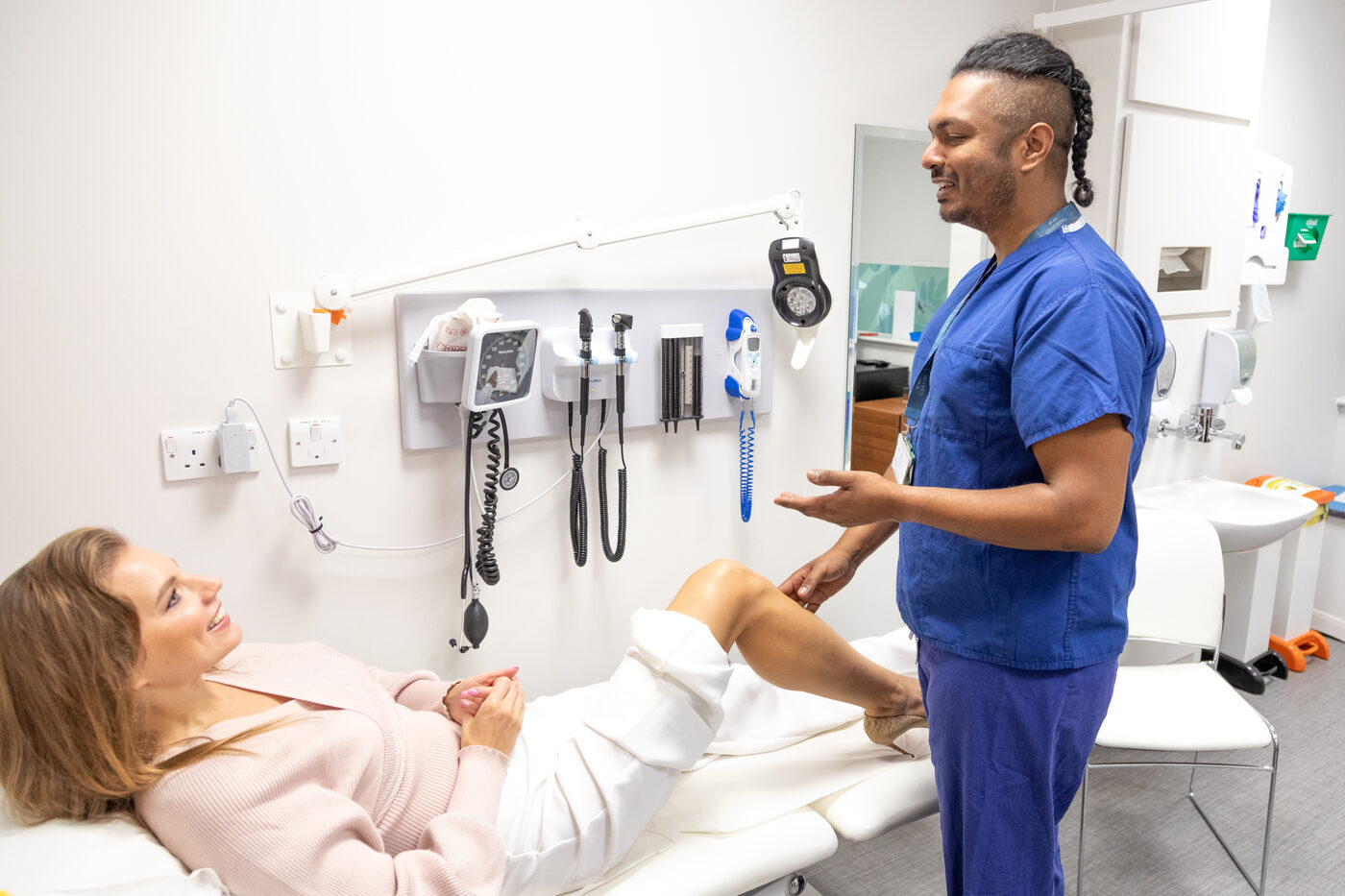
You have a place in a marathon, the long runs are building, and now your knee hurts. The fear is always the same: do I have to stop, and have I done real damage? I know that feeling from both sides. I am a knee surgeon, and I trained for and ran the London Marathon in 2024 with my own share of niggles on the way, including pain at the front of my right knee.
Most knee pain in marathon training is not a torn structure. It is a knee being asked to do more than it has been prepared for. That is good news, because it can usually be put right without stopping altogether, as long as you know which pains can be trained through and which cannot.
The short answer
Knee pain in marathon training at a glance
- Most knee pain in marathon training comes from load building faster than the knee can adapt, not from structural damage.
- Where it hurts tells you a great deal: front of the knee, outside of the knee and just below the kneecap are the common training pains.
- Pain of 3 to 4 out of 10 that settles within a day is usually acceptable to train with. Pain that climbs run after run is not.
- Swelling, locking, giving way, or bone pain that is worse at night all need to be examined before you run again.
- Strength work is the most useful thing you can add. Running alone does not make a knee strong enough for a marathon.
Why knees hurt when the miles go up
Muscle gets stronger in weeks. Tendon, cartilage and bone take much longer. A training plan can add distance faster than those tissues can keep up, and the knee is where that shows first. The pain usually appears a few weeks into a jump in mileage, a switch to hills or speed work, or a block of training done on tired legs.
This is why the same runner can be fine at 20 miles a week and sore at 35. Nothing has broken. The demand has moved ahead of the capacity. The answer is to bring the two back together: ease the load a little and raise the capacity a lot.
Where it hurts tells you what it is
Front of the knee, around or behind the kneecap. This is runner's knee, or patellofemoral pain. It is worse on stairs, downhill running and after sitting with the knee bent. It is by far the pain I see most in runners, and it responds well to strengthening the thigh and hip.
Outside of the knee. A sharp pain on the outer side that comes on at a predictable point in a run and eases when you stop is usually the iliotibial band rubbing over the outer thigh bone. Hip strength, especially the muscle on the side of the hip, is the key.
Just below the kneecap. Pain in the tendon under the kneecap, worse with hills and speed work, is patellar tendon overload. Tendons like heavy, slow loading and dislike sudden rest followed by sudden return.
Along the joint line, with swelling, catching or locking. This raises the question of a meniscus tear, and it is different from the three above. A knee that swells, catches or will not fully straighten needs examining, and often an MRI. I explain the options on my meniscus repair page.
Deep bone pain that gets worse through a run and aches at night. This can be a stress reaction in the bone. Stop running and get it looked at. It is the one pain in this list you must not train through.
Can I keep running?
Often, yes. The rule I use with patients, and with myself, is this. Discomfort of 3 to 4 out of 10 during a run is acceptable if it has settled by the next day and is not getting worse from week to week. There is research in long-standing musculoskeletal pain showing that exercising into some discomfort is safe and gives results at least as good as pain-free exercise in the short term (Smith, 2017).
If the pain is higher than that, lasts beyond 24 hours, or is climbing with each run, cut the load before the knee forces you to. Shorten the long run, take out the hills and speed sessions, run on flatter and softer ground, and replace one or two runs with a bike or pool session so your fitness holds. A week or two of this protects months of training.
Complete rest feels sensible and usually disappoints. The pain goes, you return to the same mileage on a knee that is no stronger, and it comes back.
What helps most: get stronger
If I could change one thing in most marathon plans, I would add one proper strength session a week. When trials are pooled, strength training reduces sports injuries, and stretching does not (Lauersen, 2014). Running makes you fitter. It does not load the thigh, hip and calf heavily enough to make them strong.
My own knee pain in marathon training settled with strength work, the leg extension machine in particular. I have written out the exact gym programme I use and give to every patient: eight exercises, heavy, once a week. A good physiotherapist who understands runners will tailor it and look at how you run.
It was not only my knee. In training I also had pain on the outside of my hip (greater trochanteric pain syndrome), shin splints and plantar fasciitis. Three things settled them: losing weight, strength training, and moving to a stability running shoe with support on the inner side. I run in Hoka. I am not paid by them or by any shoe company, and a shoe that suits me may not suit you, but it is worth having your running shoes looked at if the same pains keep returning.
Why did those three things work? They all do the same job from different directions: they close the gap between the force going through the leg and what the leg can take.
- Less weight means less force with every step. In a study of adults with knee arthritis who lost weight, each kilogram lost took about four kilograms of load off the knee per step (Messier, 2005). That study was in older adults who were walking, not runners, but the principle carries over, and a marathon is tens of thousands of steps.
- Stronger muscle absorbs more of the shock. Muscle is the leg's shock absorber. When it is strong and not yet tired, it takes up the impact. When it is weak or fatigued, more of that impact passes to the joint surface, the bone and the tendon attachments. Tendons also adapt to heavy loading by becoming stiffer and better able to cope with force.
- A supportive shoe changes where the load goes. If your foot rolls inwards a long way with each stride, the tissues on the inner side of the shin and under the arch are stretched thousands of times a run. A shoe with support on the inner side limits that movement. That is the likely reason my shin splints and plantar fasciitis settled, although shoes are individual and what helped me is not a rule for everyone.
Food matters as well. Hard training on too little protein and too little energy is a common reason tissues fail to keep up. I cover that on my strength training and nutrition page.
Running form, surface and taping
Strength comes first, but how you run matters too.
- Shorten your stride a little. Overstriding, where the foot lands well in front of the body, puts more load through the knee. In a laboratory study of 45 recreational runners, taking 5 to 10 per cent more steps per minute at the same speed meant the knee absorbed less energy with each step (Heiderscheit, 2011). That was healthy runners on a treadmill, so it shows a change in load, not a cure for pain, but a slightly quicker, shorter stride is a low-risk thing to try.
- Build up gradually. Most training injuries I see follow a sudden jump in distance, hills or speed work. Add one of those at a time.
- Mix your surfaces. Cambered roads and endless downhill load the knee unevenly. Flatter, softer ground is kinder while a knee is settling.
- Taping and braces can help in the short term. They can take the edge off pain at the front of the knee while you build strength. They do not replace it.
- Have your running looked at. If the same problem keeps coming back, a gait assessment with a physiotherapist who treats runners is worth the time.
Will running a marathon wear out my knees?
This is the question behind the question, and the evidence is reassuring. A pooled analysis of 25 studies covering more than 125,000 people found hip or knee arthritis in 3.5 per cent of recreational runners, compared with 10.2 per cent of people who did not run (Alentorn-Geli, 2017). That kind of study cannot prove running protects the joint, and people with sore knees may have given up running. What it does show is that recreational running is not linked to more arthritis than being sedentary.
The knees that worry me are not the ones that run. They are the ones that have had an injury that was never properly dealt with, such as a meniscus or ligament tear, and are then run on for years.
When to stop and get your knee examined
- The knee swells after runs.
- It locks, catches or will not fully straighten.
- It gives way.
- The pain is in the bone, builds through the run and aches at night.
- The pain has not improved after two to three weeks of reduced load and strength work.
- You felt a pop or a sudden sharp pain with a twist.
None of these means your marathon is over. They mean you need a diagnosis before you spend more weeks guessing.
What about an injection to get me to the start line?
I am asked this every spring. I will not inject a knee to get someone through a race without knowing what is wrong with it, because numbing a problem and then running 26 miles on it is how a small injury becomes a large one. Once we know the diagnosis, there are cases where an injection is a reasonable part of the plan. It is never the plan by itself.
We don't stack treatments. We do the right things in the right order.
How my team and I look after you
If you come to see me, I will examine your knee, arrange a scan if it is needed, and tell you plainly whether you can keep training, what to change, and whether your race date is realistic. I treat runners as people who want to run, not as people who should be told to stop. Most leave with a strength plan and a modified schedule, not an operation.
If something structural is found, I use modern keyhole techniques designed to protect the knee for the long term, and my team and the physiotherapists I work with take you from the first week back to running. You can book an appointment when you are ready.
Marathon coming up and your knee hurts?
Book a consultation. I will examine your knee and tell you whether you can keep training and what to change.
Marathon Training and Knee Pain Questions
Mild pain of 3 to 4 out of 10 that settles by the next day and is not worsening week to week is usually acceptable. Pain that is sharper, lasts more than 24 hours or climbs with each run is a signal to reduce the load. Swelling, locking, giving way or night-time bone pain should be examined before you run again.
Pain at the front of the knee around the kneecap, known as runner’s knee or patellofemoral pain. It is usually a loading problem, not structural damage, and responds well to strengthening the thigh and hip.
Complete rest is rarely the answer. Reduce the distance and intensity for one to two weeks, keep fit with cycling or swimming, and start strength work. If it has not improved after two to three weeks, get it examined.
The evidence does not support that for recreational running. In a pooled analysis of more than 125,000 people, recreational runners had less hip and knee arthritis than people who did not run, although that type of study cannot prove running is protective.
It depends on the tear. Some small, stable tears cause little trouble. A tear that makes the knee swell, catch or lock should not be run on until it has been assessed, because running on an unstable tear can make it worse and harder to repair.
References
- Alentorn-Geli E, et al. The association of recreational and competitive running with hip and knee osteoarthritis: a systematic review and meta-analysis. J Orthop Sports Phys Ther. 2017;47(6):373-390. doi:10.2519/jospt.2017.7137
- Lauersen JB, et al. The effectiveness of exercise interventions to prevent sports injuries: a systematic review and meta-analysis of randomised controlled trials. Br J Sports Med. 2014;48(11):871-877.
- Smith BE, et al. Should exercises be painful in the management of chronic musculoskeletal pain? A systematic review and meta-analysis. Br J Sports Med. 2017;51(23):1679-1687.
- Collins NJ, et al. 2018 consensus statement on exercise therapy and physical interventions to treat patellofemoral pain. Br J Sports Med. 2018;52(18):1170-1178. doi:10.1136/bjsports-2018-099397
- National Institute for Health and Care Excellence. Osteoarthritis in over 16s: diagnosis and management (NG226). 2022.
- Messier SP, et al. Weight loss reduces knee-joint loads in overweight and obese older adults with knee osteoarthritis. Arthritis Rheum. 2005;52:2026-2032. doi:10.1002/art.21139
- Heiderscheit BC, et al. Effects of step rate manipulation on joint mechanics during running. Med Sci Sports Exerc. 2011;43(2):296-302. doi:10.1249/MSS.0b013e3181ebedf4
Patient Reviews
What Our Patients Say
Verified Doctify reviews from patients who have received treatment for knee problems under the care of Dr Arj Imbuldeniya at OrthoLongevity.